
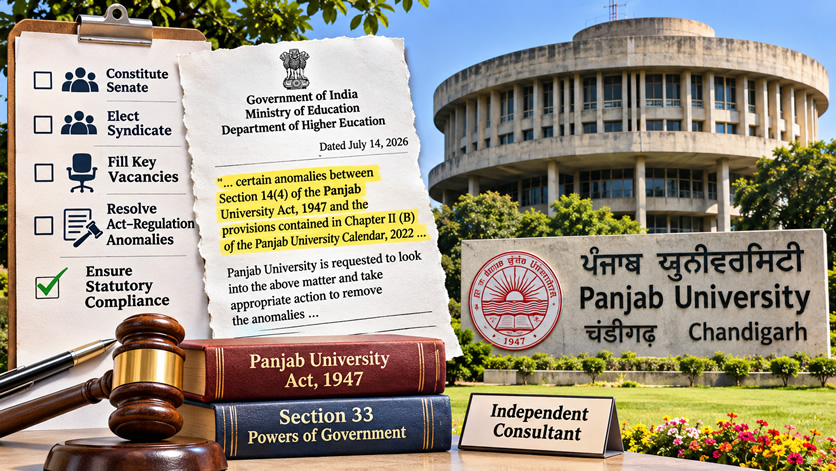
Panjab University at a Crossroads: Independent Consultant’s Intervention Brings Regulatory Anomalies under Government Scrutiny
With the Senate constitution delayed, a new Vice-Chancellor yet to assume office, and long-standing administrative vacancies continuing, Panjab University faces a critical governance transition. Meanwhile, an Independent Consultant’s sustained efforts to highlight statutory inconsistencies have brought the university’s regulatory framework under the scrutiny of the Ministry of Education, Government of India.

Panjab University, Chandigarh, is navigating a significant phase of administrative and institutional transition. Although elections to its new 91-member Senate have concluded, the university has yet to formally constitute the elected body, even after the traditional November 1 commencement of its four-year tenure. Meanwhile, the appointment of a new Vice-Chancellor on November 9 has ended the prolonged absence of a regular institutional head, although he has yet to assume charge.
These developments have created an interim governance situation at one of India’s prominent public universities, raising important questions about administrative continuity, statutory accountability and the timely resolution of long-pending institutional issues.
Amid this transition, the sustained intervention of an Independent Consultant has brought an important regulatory anomaly involving the Panjab University Act, 1947, and the university’s own Calendar and Regulations to the attention of the Department of Higher Education, Ministry of Education, Government of India.
The Ministry’s formal communication dated July 14, 2026, forwarding the consultant’s representation to the university and requesting corrective action, marks a significant development in this ongoing matter.
A New Vice-Chancellor, but Governance Challenges Remain
The appointment of a new Vice-Chancellor for a three-year term on November 9 is an important development for the university. His assumption of office is expected to restore regular leadership and provide an opportunity to address several outstanding administrative and governance matters.
However, the university continues to function with several senior positions under additional-charge (ad hoc) arrangements. The Panjab University Teachers’ Association (PUTA) highlighted the prolonged vacancies in a letter dated November 2, addressed to the Chancellor. These include:
- Registrar: Functioning under additional charge since May 2022.
- Controller of Examinations: Functioning under additional charge since November 2020.
- Dean, College Development Council (DCDC): Functioning under additional charge since 2016.
With the new Vice-Chancellor expected to assume charge shortly, responsibility for advancing pending appointments, completing the constitution of the Senate and restoring institutional normalcy will largely rest with the incoming administration.
The university’s December 5 convocation, to be presided over by Vice-President C.P. Radhakrishnan in his capacity as Chancellor of Panjab University, assumes added significance against this backdrop.
The Senate: Essential to the University’s Governance Structure
The newly elected Senate will comprise 91 members, including:
- 47 elected fellows;
- 36 members nominated by the Chancellor;
- Two nominees of the Punjab Legislative Assembly; and
- Six ex-officio members.
The formal constitution of the Senate is essential because it is the university’s supreme statutory governing and academic body under the Panjab University Act, 1947. Among its key responsibilities is electing the Syndicate, the university’s principal executive body, from among the Senate fellows.
Until the Senate is formally constituted, the university remains without the full participation of its elected apex governing body. Although routine administrative and academic functions can continue through existing arrangements, major statutory and policy decisions must follow the procedures and approvals prescribed under the Act and applicable Regulations.
Questions involving amendments to regulations, institutional policy or the interpretation of statutory provisions cannot simply be resolved through administrative decisions without the involvement of the competent statutory authorities.
The delay in constituting the Senate therefore raises broader concerns about the university’s shared-governance framework and its ability to address significant institutional matters through the appropriate statutory processes.
Independent Consultant’s Intervention: A Regulatory Anomaly Reaches the Ministry of Education
One of the most significant developments during Panjab University’s ongoing governance transition concerns a statutory inconsistency that an Independent Consultant identified and pursued independently.
The issue relates to the registration of graduates from the University of the Punjab, Lahore (Pakistan), for participation in elections to Panjab University’s governing authorities, particularly the Registered Graduates constituency.
In a representation dated March 23, 2026, the Independent Consultant highlighted anomalies between Section 14(4) of the Panjab University Act, 1947, and the provisions in Chapter II (B) of the Panjab University Calendar, 2022, concerning graduate registration.
The central concern was that the provisions in the University Calendar appeared to extend eligibility beyond the express statutory limitation in Section 14(4) of the parent Act, which refers to persons who graduated from the University of the Punjab, Lahore, before 1948.
The consultant’s representation sought to highlight the importance of ensuring that subordinate university regulations remain consistent with the parent legislation.
The Ministry’s Communication of July 14, 2026
The matter subsequently received formal attention in the Department of Higher Education, Ministry of Education, Government of India.
In an official communication dated July 14, 2026, the Ministry forwarded the Independent Consultant’s representation to the Registrar, Panjab University.
The Ministry directed:
“Panjab University is requested to look into the above matter and take appropriate action to remove the anomalies pointed out in the enclosed representation in due course.”
This communication is important for several reasons.
- It formally acknowledges the precise statutory inconsistency raised by the Independent Consultant.
- It places responsibility for examining and removing the identified anomalies upon Panjab University itself.
- Most importantly, it establishes that the issue has moved beyond an individual representation or internal university correspondence and has entered the formal administrative process of the Central Government.
Section 33: Government’s Authority to Enforce Statutory Compliance
The statutory dimension of the matter becomes particularly important when examined against Section 33 of the Panjab University Act, 1947, which deals with the Powers of Government.
The provision reads:
Section 33(1):
“The Government may require that the proceedings of the University shall be in conformity with this Act and with the Regulations and may exercise all powers necessary for giving effect to its requisitions in this behalf and may (among other things) annul, by notification, any such proceedings not in conformity with this Act or the said Regulations.”
Section 33(2):
“The exercise by the Government of any powers conferred under Sub-Section (1) shall not be liable to be called in question in any court of law.”
These provisions establish an important statutory mechanism for ensuring that the university’s proceedings remain within the framework of the Panjab University Act and its Regulations.
Section 33(1) empowers the Government to require conformity with the Act and Regulations. It also expressly authorizes the Government, among other measures, to annul, by notification, university proceedings that do not conform to the applicable statutory framework.
Section 33(2) provides that the exercise of powers under sub-section (1) cannot be challenged in court.
The Independent Consultant’s representation brought the apparent inconsistency between the parent legislation and the University Calendar to the Ministry’s attention. The Ministry’s July 14 communication subsequently requested the university to take corrective action.
Consequently, if the university does not adequately address the matter, the statutory powers available to the Government under Section 33 remain relevant for the competent authority’s consideration.
The issue, therefore, is not simply whether an administrative clarification is required. It concerns the obligation to ensure that the university’s regulations and proceedings conform to the governing legislation.
The consultant’s intervention has accordingly raised a question of wider institutional significance: whether university regulations and established administrative practices can continue without appropriate reconciliation with the provisions of the parent Act.
Right to Information: Vice-President’s Secretariat Refers the Matter to the University
The Independent Consultant has also pursued transparency and accountability through the Right to Information framework.
This referral is significant because the university is the custodian of the relevant records and the appropriate authority to provide information concerning its election procedures and administrative decisions.
The development also illustrates the consultant’s efforts to pursue the matter through multiple institutional channels, including the Ministry of Education and the Vice-President’s Secretariat.
While the RTI process primarily concerns access to existing records and information, the underlying statutory questions remain matters for examination by the competent university and Government authorities.
Together, these initiatives demonstrate a sustained effort to secure institutional transparency, statutory clarity and accountability through established administrative and legal mechanisms.
December 5 Convocation: An Opportunity for Institutional Renewal
The forthcoming 74th Annual Convocation on December 5, to be presided over by the Chancellor, Vice-President C.P. Radhakrishnan, assumes added significance in the present circumstances.
The occasion brings the university’s constitutional and academic leadership together at a time when several governance issues remain unresolved.
The immediate priorities before the incoming Vice-Chancellor and university administration include:
- Formal constitution of the new Senate: Bringing the 91-member Senate into existence and enabling it to discharge its statutory responsibilities.
- Election of the Syndicate: Completing the process necessary to restore the university’s full executive governance structure.
- Regular appointments: Filling the long-standing vacancies of Registrar, Controller of Examinations, and Dean, College Development Council.
- Compliance with Ministry directions: Responding to the Department of Higher Education’s communication dated July 14, 2026, concerning the regulatory anomalies identified by the Independent Consultant.
- Act–Regulation alignment: Ensuring that the university’s Calendar and Regulations conform to the provisions of the Panjab University Act, 1947.
These steps are essential to restoring institutional stability and ensuring that the university’s governance operates within the law.
Independent Intervention and the Road Ahead
The developments at Panjab University illustrate how independent scrutiny, supported by statutory provisions and formal representations, can bring institutional governance issues to the attention of the highest levels of Government.
The Independent Consultant’s intervention has placed a specific regulatory inconsistency on the Ministry of Education’s official record. The Ministry’s communication of July 14, 2026, is a significant milestone in this process, as it expressly identifies the provisions in question and requests the university to take appropriate corrective action.
The responsibility now rests with the university’s incoming leadership to ensure that the Ministry’s communication receives due attention and that the statutory issue is resolved in accordance with the Panjab University Act, 1947.
With the new Vice-Chancellor expected to assume charge, the new Senate still pending, and the Chancellor scheduled to preside over the December 5 convocation, the coming days could prove decisive.
The university has an important opportunity not only to restore its full governance structure but also to address long-standing regulatory concerns that have now attracted the Central Government’s attention.
Ultimately, the Independent Consultant’s efforts aim not merely to question an existing university practice, but to promote statutory compliance, transparency, and accountability in the administration of a premier public institution.
University autonomy and statutory accountability must go hand in hand. A university’s regulations cannot override its parent legislation.
Under Watch
Having formally requested the university to examine the anomalies identified by the Independent Consultant and take appropriate corrective action, the Ministry’s communication places the responsibility squarely on the university administration.
The crucial question now is whether the incoming Vice-Chancellor and the university authorities will act upon the Ministry’s directions and bring the relevant provisions of the University Calendar and Regulations into conformity with the Panjab University Act, 1947.
The university’s response, or continued silence, will be significant in determining whether further intervention by the Central Government under Section 33 of the Act becomes necessary.
“If Panjab University fails to take corrective action in compliance with the Ministry’s directions, the Government may be left with no option but to exercise its statutory powers under Section 33 of the Panjab University Act, 1947, and act on its own.”

