
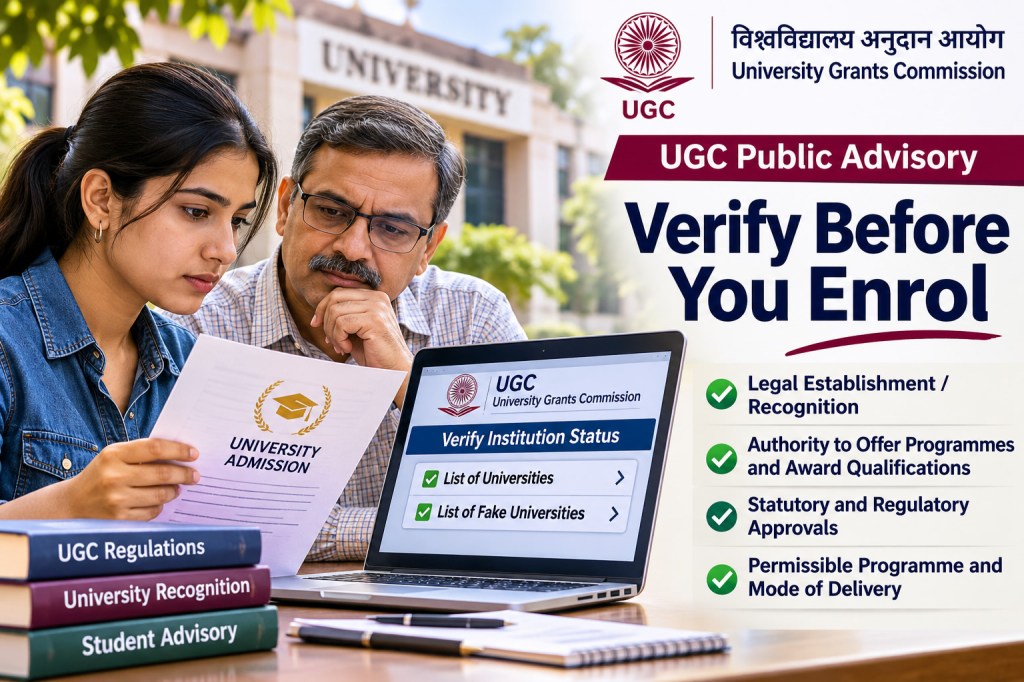
UGC Issues Public Advisory Urging Students to Verify Recognition and Legal Status of Educational Institutions
Warns students and parents against misleading claims about institutional recognition, regulatory approvals, and authority to award degrees
The University Grants Commission (UGC) has issued a significant Public Advisory urging students, parents, guardians and members of the general public to exercise due caution and independently verify the legal status and authenticity of educational institutions before seeking admission or entering into any academic or financial arrangement.
Dated November 17, 2026, the advisory has been issued in pursuance of the directions of the Supreme Court of India vide its order dated October 9, 2026. Taking note of activities relating to educational institutions operating in the country, the UGC has emphasized the need for greater public awareness to protect students and families from potentially misleading claims and unauthorized academic offerings.
Four essential checks before taking admission
The UGC has advised prospective students and other stakeholders to verify four key aspects before making an academic or financial commitment:
1. Legal establishment or recognition
Students should confirm whether the educational institution is legally established or recognized under applicable laws.
2. Authority to offer programs and award qualifications
Verify whether an institution is legally authorized to offer the particular academic program and award the corresponding degree or qualification under the University Grants Commission Act, 1956, and other applicable laws.
3. Statutory and regulatory approvals
Prospective students should confirm whether the institution has obtained all requisite recognition, approvals and permissions from the UGC and other concerned statutory or regulatory authorities, wherever applicable.
4. Permissibility of the program and mode of delivery
The advisory also stresses the importance of checking whether the program, mode of study and location of delivery are legally permitted. This includes distance education, online education, off-campus centers and study centers.
Warning against misleading advertisements and claims
In an important cautionary message, the UGC has advised the public not to rely solely on advertisements, institutional websites, brochures, social media posts, or claims made by educational institutions about their recognition, affiliation, approvals, or authority to award degrees.
Instead, verify such claims independently through official sources, including the UGC website and the websites of the relevant statutory and regulatory authorities.
The Commission has specifically drawn attention to two important resources published on its website:
- List of Universities: The UGC’s category-wise list of universities.
- List of Fake Universities: The official list identifying institutions that are not recognized as universities under the applicable legal framework.
These resources can help students and parents determine whether an institution has the requisite legal standing before committing to an academic program.
Protecting students from academic and financial risks
The advisory is especially important at a time when students have access to an increasingly diverse range of educational institutions and programs, including online and distance-learning courses. While these developments have expanded educational opportunities, they have also made it important for prospective students to distinguish between legally recognized institutions and those making unauthorized or misleading claims.
An institution’s existence, promotional activities, or use of terms such as university, institute, international campus, or affiliated center should not, by themselves, be treated as evidence of legal recognition or authorization to award degrees.
The UGC’s advisory reinforces the principle that students must exercise informed judgment and verify an institution’s legal and regulatory credentials before investing their time, money, and academic aspirations.
A call for wider public awareness
The UGC has requested all concerned authorities and educational institutions to widely publicize the advisory to promote awareness and safeguard the academic and financial interests of students and the general public.
By reiterating the need for independent verification, the Commission has placed an important responsibility on students, parents and educational stakeholders to ensure that academic decisions are based on authentic information rather than unverified institutional claims.
The message is clear: Before enrolling in any educational institution or program, verify its legal recognition, regulatory approvals, and authority to award the qualification. A little caution before admission can prevent significant academic and financial consequences later.
Source: Public Advisory issued by the University Grants Commission, dated November 17, 2026, pursuant to the directions of the Supreme Court of India dated October 9, 2026.

