
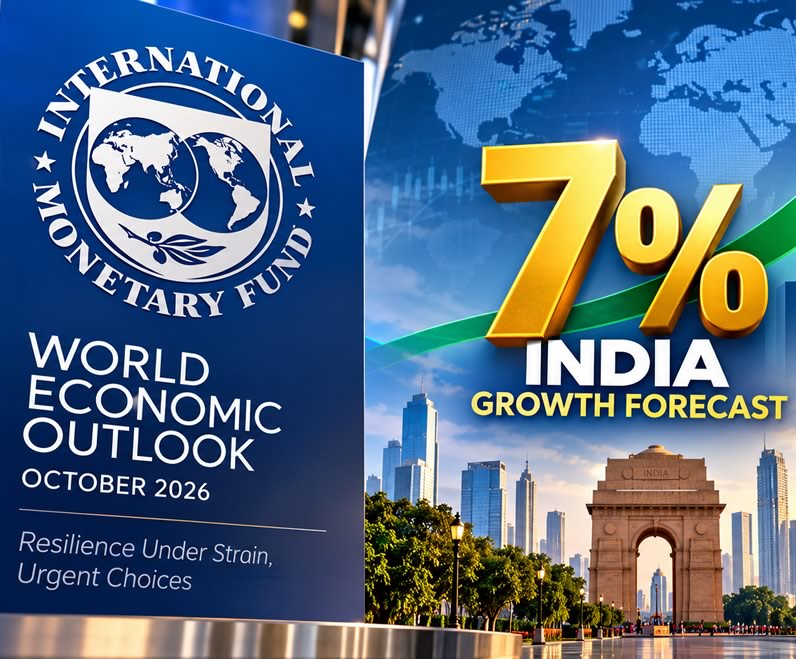
IMF’s October 2026 Outlook: India’s 7% Growth Forecast Shines Amid Global Economic Uncertainty
India’s resilient domestic demand, expanding services sector and favorable demographics strengthen its growth prospects, even as geopolitical tensions and higher energy prices test the global economy.

BANGKOK, October 13, 2026 — At a time when geopolitical conflict, rising energy costs and uneven global investment are clouding the economic outlook, India has emerged as a bright spot in the International Monetary Fund’s latest assessment of the world economy.
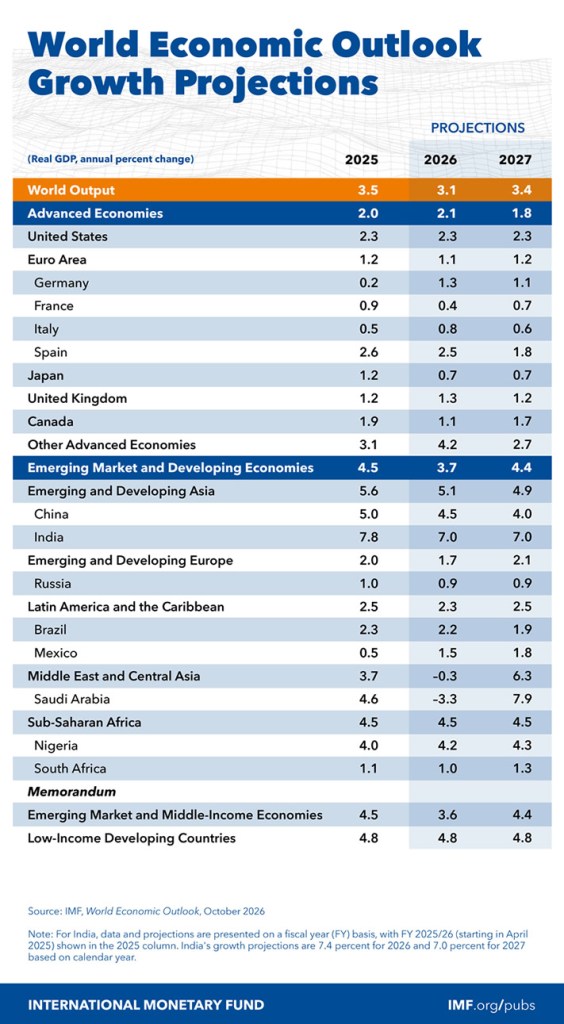
The IMF’s October 2026 World Economic Outlook (WEO), titled Resilience Under Strain, Urgent Choices, projects India’s economy to grow by 7.0% in both FY2026–27 and FY2027–28, underscoring the country’s continued strength among the world’s major economies. The latest forecast marks a substantial upward revision from the IMF’s July 2026 projection of 6.4% for FY2026–27.
Released in Bangkok during the IMF–World Bank Annual Meetings, the report presents a global economy that has proved more resilient than expected but is increasingly vulnerable to further shocks. Against this uncertain backdrop, India’s growth trajectory highlights the importance of domestic demand, services-sector strength, structural reforms and favourable demographic fundamentals.
Yet the message is not one of unqualified optimism. Even as India benefits from strong economic momentum, its exposure to imported energy, global financial volatility and geopolitical disruptions means that sustaining growth will require continued policy discipline.

India’s growth story gains fresh momentum
The IMF’s upward revision reflects stronger-than-expected economic activity, resilient domestic consumption and robust services-sector performance. Together, these factors have helped India absorb some of the pressure from elevated oil prices and a challenging international environment.
The report points to growing evidence that India’s underlying growth potential is being supported by favourable demographic dynamics, a large and expanding domestic market, and continued structural reforms.
These fundamentals distinguish India from several economies facing weaker prospects as the consequences of the Middle East conflict spread through energy markets, trade networks and financial conditions.
A substantial domestic market gives Indian businesses a broader base of demand, while the expansion of services activity supports economic output even when external conditions become less favorable. Demographic advantages, meanwhile, offer opportunities to strengthen productivity, employment and long-term income growth—provided that investment in skills, infrastructure and productive capacity keeps pace.
The revised forecast is therefore significant for more than its headline number. It reflects confidence in the resilience of India’s economic expansion and the potential for its structural strengths to support growth over the medium term.
The global economy: Resilience under strain
While India’s outlook has improved, the IMF’s assessment of the global economy remains cautious.
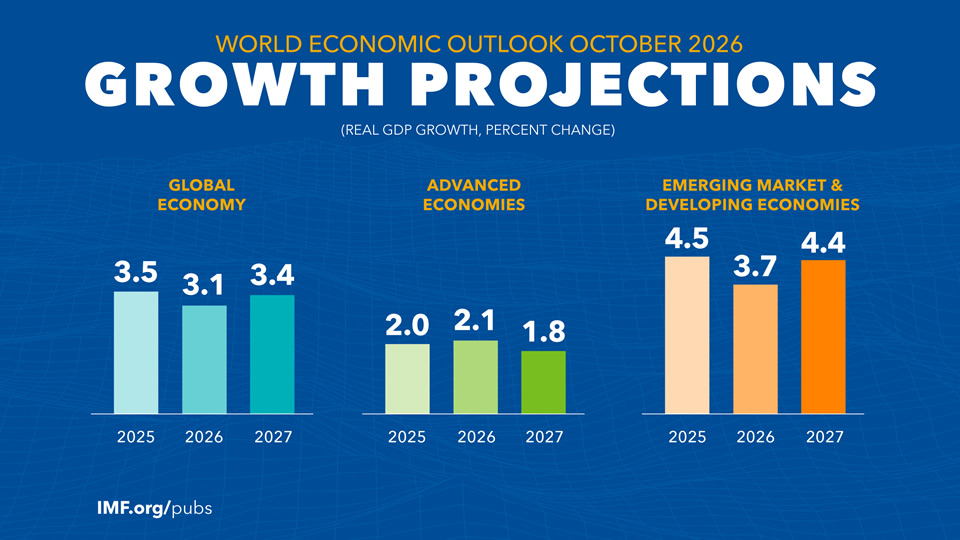
The report projects global growth of 3.1% in 2026, a modest 0.1 percentage-point improvement over the July forecast but slower than the 3.5% expansion recorded in 2025. Growth is expected to reach 3.4% in 2027.
The headline figures, however, conceal increasingly uneven economic conditions. Countries benefiting from artificial intelligence-related investment and favourable terms of trade are performing relatively better, while many energy-importing economies outside the AI technology value chain face greater pressure.
The Middle East conflict and its associated energy shock have complicated the global recovery. Higher oil and food prices are expected to push global headline inflation to 4.7% in 2026 before it moderates to 4.1% in 2027. The IMF’s oil-price assumption averages approximately $96 per barrel for 2026.
These pressures create a difficult balancing act for policymakers: supporting economic activity without allowing inflation to become entrenched.
The report’s central warning is that resilience should not be mistaken for immunity. Businesses and governments have adapted to successive shocks, but the buffers that have supported the global economy are becoming thinner, leaving less room to absorb another major disruption.

India versus the world: A striking growth differential
India’s projected 7.0% growth rate in both fiscal years stands out against a subdued outlook across several major economies.
The United States is projected to expand by approximately 2.3% in both 2026 and 2027. The euro area is expected to grow by around 1.1% in 2026 and 1.2% in 2027, while China’s growth is forecast at 4.5% in 2026 and 4.0% in 2027.
India’s projected expansion is therefore significantly faster than that of these major economic centres, reinforcing its importance to global growth.
The comparison also highlights an important distinction: India’s prospects are supported substantially by domestic economic activity, while other economies face different combinations of energy exposure, trade pressures and investment-related uncertainty.
However, growth rates alone do not capture the full picture. The quality of growth, employment generation, productivity improvements and the distribution of economic gains will remain essential measures of India’s long-term progress.
Inflation and oil prices: The challenge India cannot ignore
Despite the stronger growth forecast, inflation remains a critical consideration.
The IMF projects Indian consumer-price inflation at approximately 5.0% in 2026, easing towards 4.4% in 2027. Although these projections suggest some moderation ahead, persistent energy-price pressures could complicate the inflation outlook.
As a major importer of crude oil, India remains exposed to international price movements. Sustained increases in oil prices can raise transportation and production costs, affect household purchasing power, put pressure on businesses and complicate the management of inflation.
Higher energy costs can also influence the external balance and the government’s fiscal position, particularly if measures are introduced to cushion consumers from price increases.
India’s strong domestic demand provides an important source of support, but it does not eliminate these vulnerabilities. A prolonged conflict or further disruption to energy supplies could create a more difficult combination of slower growth and higher inflation.
The challenge for policymakers will be to protect economic momentum while maintaining price stability and ensuring that assistance reaches households and businesses most affected by the shock.

Trade agreements and supply-chain resilience
India’s longer-term economic prospects will also depend on its ability to strengthen international trade relationships and deepen its integration into global supply chains.
The IMF’s assessment points to the potential benefits of trade agreements, including those with the European Union and the United Kingdom, in supporting trade diversification and supply-chain resilience.
A broader network of trade partnerships can create opportunities for exporters, encourage investment and help businesses reduce their dependence on individual markets. It can also improve India’s ability to participate in the reorganisation of global production as companies reassess supply-chain risks.
Realising these benefits, however, will require more than market access. Competitive manufacturing, reliable infrastructure, workforce skills, regulatory predictability and stronger domestic value addition will be important to translating trade opportunities into sustained investment and employment.
India’s expanding services economy is already an important source of strength. The next challenge is to ensure that manufacturing, technology adoption and labour-intensive industries also contribute meaningfully to the country’s growth and job creation.
Artificial intelligence: Opportunity amid uncertainty
Artificial intelligence is another major force shaping the IMF’s global outlook.
The report identifies AI-related investment as an important source of economic support, particularly for countries and businesses connected to the technology value chain. Strong investment in computing infrastructure, digital capabilities and related technologies has helped offset some of the adverse effects of geopolitical and energy shocks.
Yet the IMF also warns that expectations surrounding AI could prove too optimistic. A reassessment of anticipated productivity gains could trigger financial-market corrections, weaken investment and expose vulnerabilities associated with elevated valuations.
For India, the AI transition presents both an opportunity and a strategic challenge.
The country’s established technology-services sector, expanding digital ecosystem and substantial talent base offer potential advantages. But capturing the full economic benefits of AI will require broader adoption across industries, sustained investment in skills and innovation, and efforts to ensure that productivity gains translate into stronger competitiveness and wider economic participation.
The central question is not simply whether AI investment expands, but whether it generates durable productivity improvements and creates opportunities across the wider economy.
The IMF’s policy message: Rebuild resilience before the next shock
The October WEO calls for governments to move beyond short-term crisis management and rebuild the economic buffers needed to withstand future disruptions.
Its policy priorities include:
- Fiscal discipline: Countries with elevated public debt should exercise restraint and rebuild fiscal space, undertaking credible consolidation where necessary.
- Price stability: Monetary policy should remain sufficiently restrictive to contain second-round inflation effects, while central-bank independence is preserved.
- Targeted assistance: Governments should favour temporary, targeted support for vulnerable households over broad price controls that can distort economic signals and become fiscally costly.
- Supply-side resilience: Investment in infrastructure, productive capacity and economic adaptability can reduce exposure to future supply shocks.
- International cooperation: Stronger coordination is needed to address geopolitical tensions, trade disruptions and cross-border economic spillovers.
The report’s lessons from previous cost-of-living crises reinforce the case for targeted transfers rather than indiscriminate subsidies. Its analysis of corporate income taxation also underscores the importance of considering international spillovers and protecting public investment capacity when governments change tax policies.
For India, these principles are particularly relevant. Maintaining macroeconomic stability while investing in infrastructure, human capital, innovation and productive employment will be essential to sustaining rapid growth.
The country’s demographic advantage can deliver substantial economic dividends, but only if a growing workforce is matched by opportunities to develop skills, raise productivity and participate in higher-value economic activity.

The road ahead: Turning growth into lasting prosperity
The IMF’s October 2026 outlook presents an encouraging assessment of India’s immediate economic prospects. The upward revision to 7.0% growth in FY2026–27, followed by another 7.0% in FY2027–28, signals confidence in the country’s momentum even as global risks intensify.
But the wider message of Resilience Under Strain, Urgent Choices deserves equal attention. Economic resilience is valuable precisely because it is tested—and it cannot be taken for granted.
India will need to manage energy-price volatility, preserve inflation control, encourage private investment, strengthen export competitiveness and expand the productive capacity of its workforce. Continued structural reforms will be important not only for maintaining headline growth but also for ensuring that the benefits reach a wider cross-section of the population.
The country’s large domestic market, favourable demographics and services-sector strength provide a substantial foundation. The task now is to convert these advantages into sustained productivity gains, more productive employment and deeper integration into global value chains.
The bottom line: India enters the next phase of global economic uncertainty with a stronger growth outlook than the IMF anticipated just a few months ago. Its projected 7% expansion offers a compelling contrast with the more subdued performance of many major economies. Whether that advantage endures will depend on how effectively India combines macroeconomic stability with reforms, investment and inclusive growth.
In a world where resilience is becoming harder to sustain, India’s opportunity is not merely to grow faster than its peers—but to build an economy capable of doing so through the next cycle of global disruption.
The author holds advanced professional credentials from the Institute for Capacity Development at the International Monetary Fund (IMF).

