
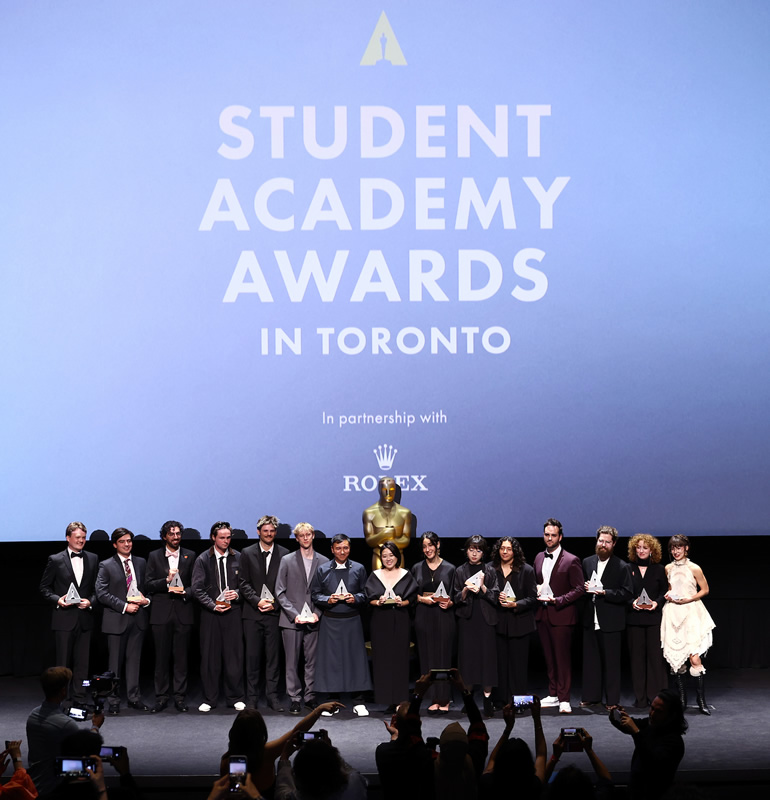
2026 Student Academy Awards: Where the Future of Cinema Takes the Stage
From university classrooms to the world’s most prestigious film industry stage, the Student Academy Awards are proving that tomorrow’s cinematic voices are already making themselves heard.

The future of cinema arrived in Toronto this week—not from a Hollywood studio lot, but from college and university campuses worldwide.
At the 53rd Student Academy Awards® ceremony, the Academy of Motion Picture Arts and Sciences honored a new generation of filmmakers whose work emerged from classrooms, film schools, and university programs worldwide. Held at TIFF Lightbox at Reitman Square during the Toronto International Film Festival, the ceremony underscored an increasingly important truth about filmmaking: the next wave of cinematic talent is already here.
The scale of this year’s competition makes that point particularly compelling. The 2026 Student Academy Awards attracted 2,972 entries from 894 colleges and universities worldwide. From thousands of submissions, only a small group emerged with Gold, Silver, or Bronze honors in Alternative/Experimental, Animation, Documentary, and Narrative filmmaking.
And for the winners, the prize is about far more than a trophy.
A global classroom for cinema

The geographical diversity of the winners is striking.
In Alternative/Experimental, Gold went to Lei He of Duke University in the United States, while Viktorie Štěpánová of Prague’s FAMU received Silver and Nina Broers of the Netherlands’ St. Joost School of Art & Design received Bronze.
Animation brought together talent from France and Germany. Jonathan Lally, Elio Molinaro and Nicolás Acevedo Ferraté of ESMA in France won Gold for COWS, with Silver going to Matthias Strasser of Film Academy Baden-Württemberg for The Panic Inside. Noran Fikri Alezabi, Xinyue Ma and Yulin Yue of Gobelins received Bronze for Gauze.
Lara Dihmis of New York University won Documentary Gold for The Last People of Petra. Jason Elliott of the National Film and Television School in the United Kingdom won Silver for I Want to Live, while Arjun Fischer of the University of Southern California received Bronze for Artificial Love.
In Narrative, Stanzin Jigmet of ESCAC in Spain won Gold for The Dragon Letter. Antoine Boulanger of Concordia University in Canada received Silver for The Pichenotte, while Leon Korzyński of Warsaw Film School in Poland won Bronze for Kamathipura Express.
These are not simply institutional affiliations on a winners’ list. Together, they represent a global ecosystem of film education—and a reminder that compelling cinema can emerge from virtually anywhere.
The Oscar connection changes everything

This year’s awards also carry a particularly significant dimension.
Every Student Academy Award-winning film is eligible to compete for the 99th Oscars® in the Animated Short Film, Live Action Short Film, or Documentary Short Film category.
That transforms the Student Academy Awards from an academic distinction into a genuine launchpad for professional filmmaking careers.
History offers compelling evidence. Past Student Academy Award winners include Spike Lee, Robert Zemeckis, Pete Docter, Patricia Cardoso and Patricia Riggen. Collectively, former Student Academy Award winners have earned 70 Oscar nominations and won or shared 15 Academy Awards.
The message to today’s winners is therefore unmistakable: the student film is not necessarily the final project before a career begins. It can be the project that begins the career.
Beyond the trophy

The Academy’s post-award support may be just as consequential as the awards themselves.
Winners are paired with Academy members and receive educational programming, networking opportunities, and access to industry professionals through the Academy Gold Mentorship Program and Alumni Network.
This is where the awards become more than recognition.
Film education can teach craft, but careers are also built through relationships, mentorship, and access. A talented student may know how to tell a story but still lack the professional network needed to bring that talent into the wider industry. The Academy’s effort to connect winners with established filmmakers and industry professionals addresses precisely that gap.
The Student Academy Awards thus operate as both a competition and a bridge—from education to profession.
New schools enter the spotlight

The 2026 awards also mark first-time honors for students from Concordia University, Duke University, ESMA, ESCAC, St. Joost School of Art & Design and Warsaw Film School.
That matters because institutions shape cinematic cultures as much as individual filmmakers do. Every new school entering the winners’ circle expands the geography of recognized filmmaking talent.
It also sends an encouraging signal to film students working far from traditional industry centers: cinematic opportunity does not have to begin in Hollywood.
Toronto provides the setting

Holding the ceremony in Toronto during TIFF adds another layer of significance.
Toronto has become one of the world’s major meeting places for international cinema, bringing together filmmakers, audiences, critics, distributors, and industry professionals. Placing emerging filmmakers in that environment connects student achievement with the larger global film conversation.
The ceremony, supported by longtime Academy partner Rolex, also reflects the broader importance of investing in the next generation of cinematic talent. Rolex’s partnership with the Academy emphasizes excellence, achievement, and the transfer of cinematic knowledge—values particularly relevant to a program designed around emerging filmmakers.
The real award is what comes next

The Student Academy Awards were established in 1972 to give emerging filmmakers a platform and create opportunities to showcase their work within the film industry. More than five decades later, that mission has become increasingly consequential.
Cinema is undergoing profound change. Technology is transforming production and distribution. Artificial intelligence is beginning to reshape creative workflows. Audiences are consuming stories across theatrical screens, streaming platforms, mobile devices, and new digital formats. Yet amid all these changes, the essential challenge remains the same: finding distinctive storytellers with something meaningful to say.
The 2026 Student Academy Awards suggest that those storytellers are already emerging.
The Gold, Silver and Bronze trophies presented in Toronto may mark an achievement in a student’s education. But Oscar eligibility, mentorship, professional connections, and an alumni network point to something much bigger.
The Student Academy Awards are not simply celebrating today’s filmmakers. They are investing in the filmmakers who may define cinema tomorrow.
And if the history of the awards is any indication, some of the names announced in Toronto this year may one day be read from an Oscar® stage in Los Angeles.
 CitiTimes