
A Stamp for an Enduring Promise: USPS Marks 250 Years of the Declaration of Independence

On July 4, 2026, the United States celebrated far more than another Independence Day. It marked 250 years since the adoption of the Declaration of Independence, the document that transformed thirteen British colonies into a nation founded on the revolutionary principles of liberty, equality, and self-government. To commemorate this historic milestone, the United States Postal Service unveiled its new Declaration of Independence Forever Stamp in Philadelphia—the birthplace of American independence.
The unveiling is more than a philatelic event. It is a symbolic reminder that even in an age dominated by digital communication, postage stamps remain miniature ambassadors of national history, carrying stories that transcend generations.
A Fitting Tribute in America’s Birthplace
The dedication ceremony took place at the historic B. Free Franklin Post Office, located within Independence National Historical Park. Few venues could have been more appropriate.
Philadelphia occupies a unique place in American history. It was here that delegates of the Second Continental Congress debated independence, approved the Declaration on July 4, 1776, and laid the foundations of a new republic. It is also closely linked to Benjamin Franklin, who became the first Postmaster General of the United Colonies in 1775, establishing a postal network that would evolve into today’s USPS.
By choosing this location, the Postal Service connected two enduring American institutions born during the nation’s earliest days: constitutional democracy and the postal system.
More Than a Historical Document
The Declaration of Independence remains one of history’s most influential political texts.
Its assertion that all people are created equal and possess inherent rights—including life, liberty, and the pursuit of happiness—introduced ideas that challenged the dominant political order of the eighteenth century. Rather than deriving authority from monarchs or inherited privilege, governments, the Declaration argued, derive “their just powers from the consent of the governed.”
Those principles have never been static. While the United States has often struggled to fully fulfill them, they have continually served as a moral benchmark against which successive generations have measured the nation’s progress.
As USPS Board of Governors Secretary Lucy Trout observed during the dedication ceremony, the Declaration has functioned as America’s enduring mission statement, inspiring citizens over two and a half centuries to work toward realizing its promises more fully.
The Revolution Began With Ideas

The Declaration did not emerge overnight.
Years of mounting tensions between the American colonies and Great Britain—including taxation without representation, restrictions on colonial self-government, and growing political unrest—set the stage for independence.
The influential pamphlet Common Sense, written by Thomas Paine in early 1776, galvanized public opinion by making a compelling case for complete separation from the British Crown.
When the Continental Congress appointed a drafting committee, Thomas Jefferson, only 33 years old, prepared the first draft. After debate and revisions, Congress voted for independence on July 2, with the final Declaration adopted two days later.
Its influence soon reached beyond America’s borders, inspiring democratic movements across Europe, Latin America, and elsewhere, while later becoming a touchstone for abolitionists, advocates of women’s suffrage, and civil rights leaders within the United States.
A Design That Speaks Through Simplicity
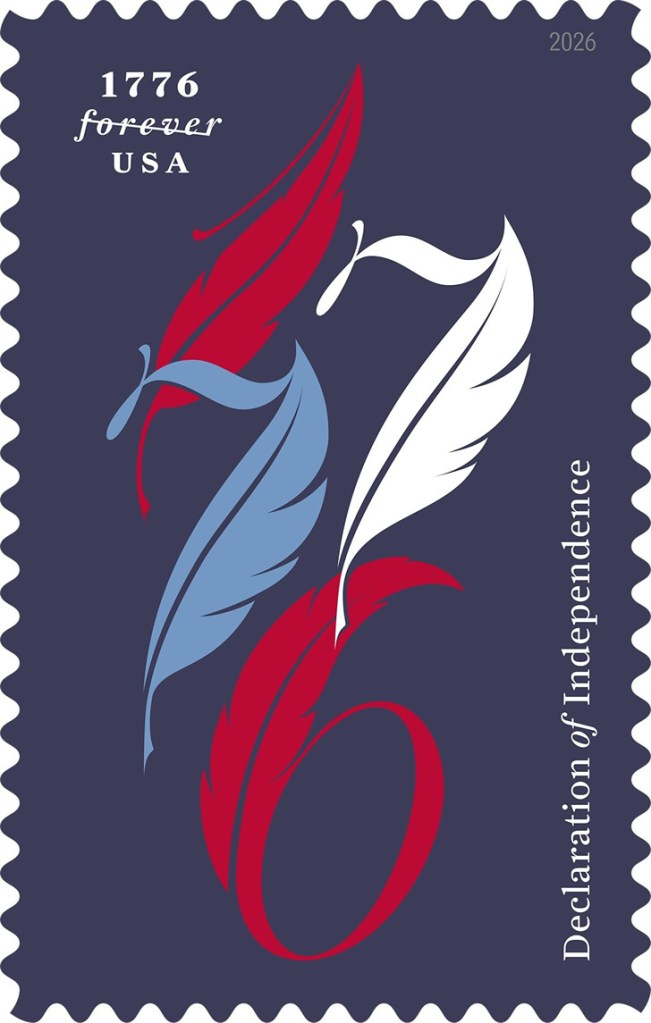
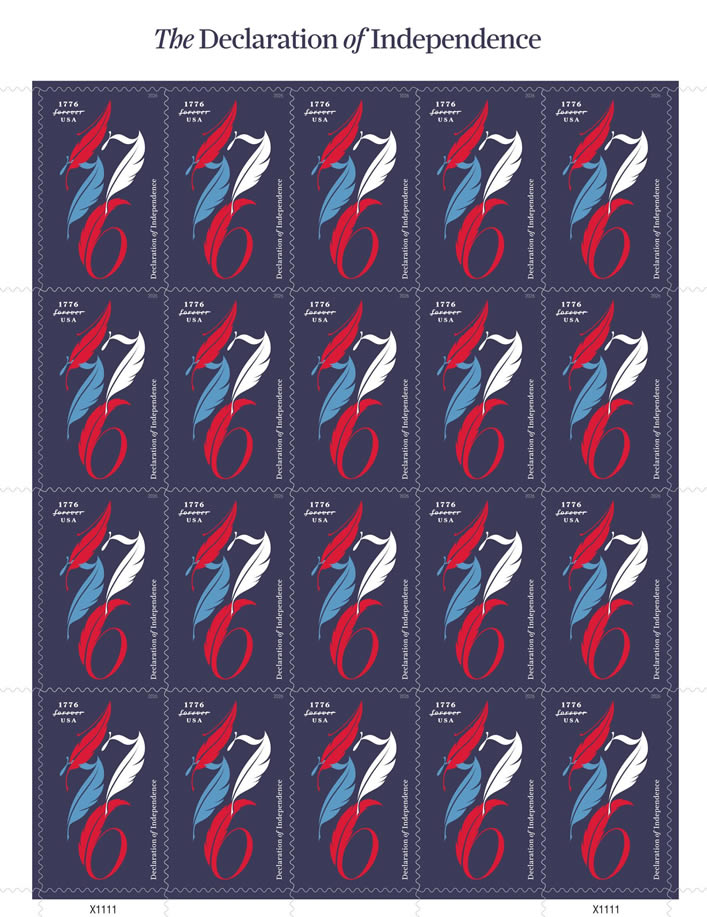
The new Forever Stamp embraces a striking minimalist design.
Created by designer Juan Carlos Pagan under the art direction of Greg Breeding, the stamp features the year 1776 arranged vertically against a deep blue background. Each numeral is shaped like a feather quill—a subtle but effective tribute to the writing instruments used by the 56 signers of the Declaration.
The red, white, and blue color palette reinforces its patriotic theme while avoiding visual excess, allowing the symbolism of the quill and the historic year to take center stage.
Issued in panes of twenty, the stamp joins the long tradition of USPS commemoratives celebrating defining moments in American history. As a Forever Stamp, it will always retain its value for standard First-Class Mail regardless of future postal rate changes.
Small Stamp, Big Symbolism

The USPS has commemorated the Declaration before, most notably during the nation’s Bicentennial in 1976. Yet the Semiquincentennial—the 250th anniversary—offers a different perspective.
Rather than merely looking backward, the anniversary encourages reflection on how the Declaration continues to shape public life. Its ideals remain central to debates over democracy, representation, civil liberties, and equal rights not only in the United States but around the world.
Today, the original Declaration is preserved at the National Archives Museum, where millions visit each year to see the document that fundamentally altered the course of modern political history.
The Editorial View
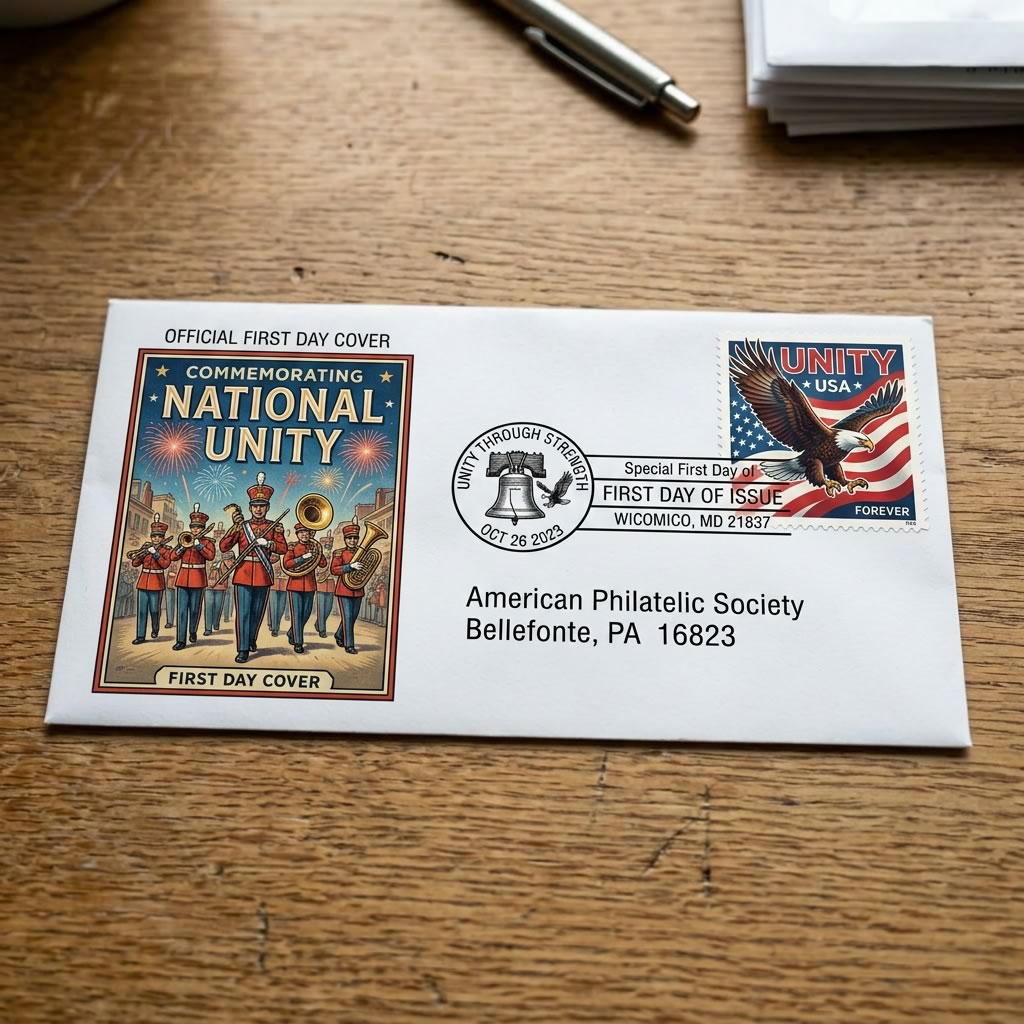
Commemorative stamps may be small in size, but they often carry immense historical weight. The USPS’s Declaration of Independence Forever Stamp succeeds because it does more than celebrate an anniversary—it invites reflection.
In an increasingly digital era, physical symbols still possess remarkable power. A postage stamp travels across cities, states, and continents, quietly reminding its recipients of shared history and enduring ideals. This latest issue recognizes that the Declaration of Independence is not simply an artifact preserved behind museum glass; it remains a living statement whose principles continue to challenge every generation to strengthen democracy and expand liberty.
As America marks 250 years of independence, the newest Forever Stamp serves as a fitting tribute—not only to the birth of a nation, but to the enduring aspiration that governments exist to protect the rights and dignity of the people they serve.

