
Higher Education Governance
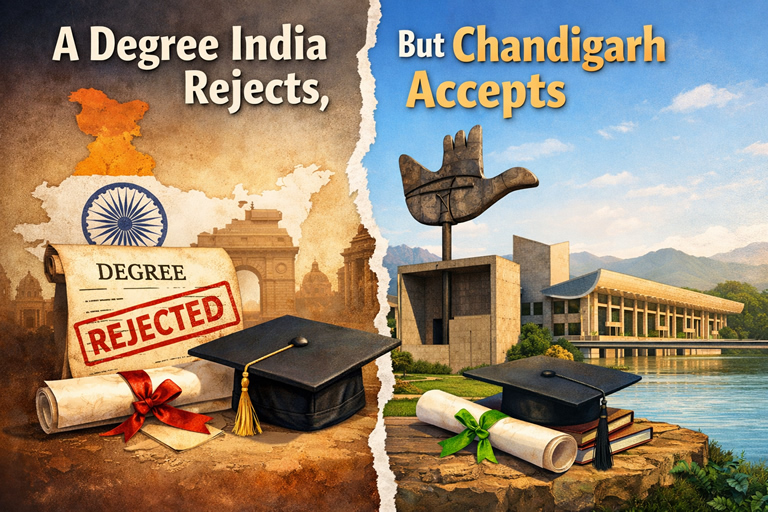
How Can Unrecognized Degrees Qualify Voters in a University Senate Election?
The Panjab University Senate Election Paradox
By Surender Hastir
A national policy clearly states that degrees from Pakistani universities are not recognized in India. Yet documentation surrounding the 2026 Senate elections at Panjab University, Chandigarh, appears to allow graduates of the University of the Punjab, Lahore, Pakistan, to enroll as Registered Graduates—raising serious questions about regulatory consistency and institutional governance.
A Policy That Draws a Clear Line
At present, a degree awarded by a Pakistani public university—such as the University of the Punjab, Lahore—is not considered equivalent to a degree granted by an Indian public university, such as Panjab University, Chandigarh, for any official purpose in India.
India’s higher education regulators, the University Grants Commission and the All India Council for Technical Education, made this position explicit through a joint public notice issued on April 22, 2022. The notice states that degrees issued by any educational institution in Pakistan shall not be recognized in India.
This policy remains in force, with no indication of reversal or modification as of 2026. The restriction applies broadly to all academic qualifications obtained from Pakistani institutions, irrespective of their reputation, accreditation, or standing within Pakistan.
A Decision Rooted in Geopolitics
Importantly, this regulatory stance is not primarily a judgment about academic merit.
Universities in Pakistan operate within their own national accreditation framework under the Higher Education Commission of Pakistan. Prior to 2022, degrees from accredited Pakistani universities were eligible for equivalence evaluation in India.
Once such equivalence was granted, the degrees could be used for academic progression, including admission to postgraduate programs in Indian universities.
The 2022 notice effectively closed that pathway, reflecting broader geopolitical and security considerations rather than a direct reassessment of academic standards.
Comparable Institutions, Separate Legal Systems
Even when viewed strictly from an academic perspective, a degree from the University of the Punjab, Lahore, and one from Panjab University, Chandigarh, cannot be treated as identical.
The two universities function under different national jurisdictions, statutory frameworks, and regulatory regimes. Their governing laws, accreditation structures, and administrative systems are distinct.
Thus, while their academic traditions share historical roots dating back to pre-Partition Punjab, their degrees today exist within separate legal and institutional ecosystems.
The Senate Election Paradox
This legal reality raises a troubling question in the context of the 2026 Senate elections at Panjab University.
If degrees from Pakistani universities are not recognized in India for official purposes, how can graduates of the University of the Punjab, Lahore, Pakistan, be allowed to enroll as Registered Graduates of Panjab University, Chandigarh?
Under the university’s electoral framework, Registered Graduates enjoy important institutional privileges. They are eligible to vote in Senate elections and even contest seats in the university’s governing body.
Yet official documents related to the Senate Elections 2026—including the Application for Enrolment as Registered Graduate, 2026 and the election notice issued by the Registrar—appear to permit precisely such enrollment.
An Institutional Contradiction
If this interpretation is correct, the situation raises a fundamental contradiction.
A degree that is not recognized for academic or official purposes in India should logically not serve as the basis for participation in the governance of a statutory Indian university.
Allowing such participation would create a paradox:
A qualification deemed invalid for recognition suddenly becomes valid for electoral eligibility within a public university’s governing structure.
A Question That Demands Clarity
At stake here is not merely a procedural technicality but a matter of institutional coherence and regulatory consistency.
If the national policy denying recognition to Pakistani degrees remains operative, then Panjab University must clarify how such qualifications could qualify an individual to vote in—or contest—the university’s Senate elections.
Until this question is addressed, the situation appears preposterous, irrational, and institutionally untenable.
Public universities derive their legitimacy from the clarity of their rules and their consistency with national regulatory frameworks. When policy and practice appear to diverge, transparency and explanation are not optional—they are essential.
A qualification deemed invalid for recognition in India cannot logically become valid for participation in the governance of an Indian public university.
The author, Surender Hastir, writes on higher education governance, university regulation, and public policy in India.
 CitiTimes