
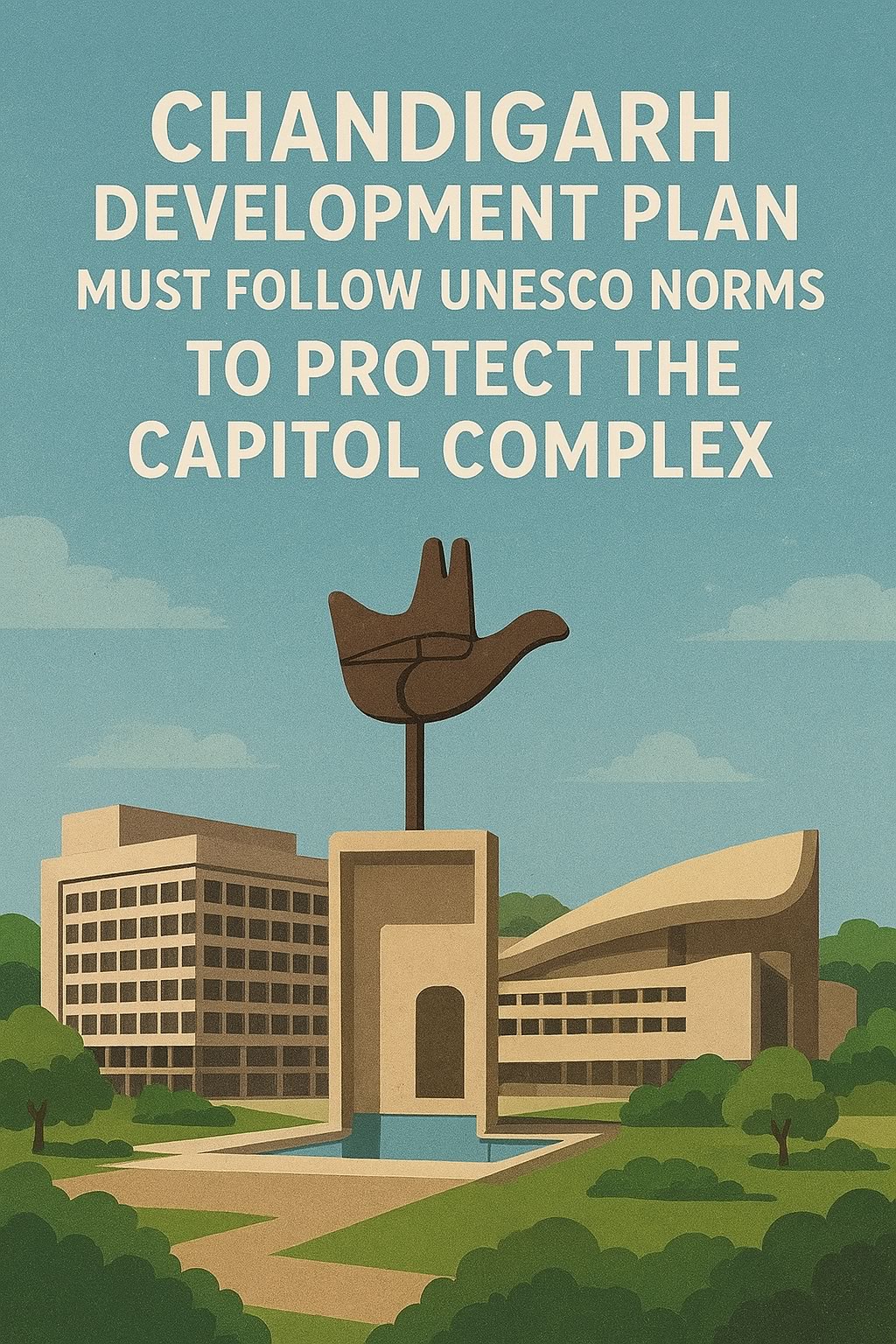
Chandigarh Development Plan Must Follow UNESCO Norms to Protect the Capitol Complex
By CitiTimes Editorial Desk
Chandigarh | January 21, 2026
The future of the Chandigarh Capitol Complex—a globally celebrated symbol of modern architecture—has once again come into sharp focus. At the 26th meeting of the Chandigarh Heritage Conservation Committee (CHCC), held under the chairmanship of H. Rajesh Prasad, Chief Secretary, U.T. Chandigarh, a clear message emerged: any development plan for the Capitol Complex must strictly comply with UNESCO norms and international heritage standards.
Heritage Before Development
The meeting reviewed the proposed Holistic Development Plan for the Punjab and Haryana High Court Complex, a key component of the Capitol Complex designed by Le Corbusier. Chief Architect-cum-Member Convener Rajiv Kumar Mehta briefed the committee on the background of the plan, the legal context, and the series of court directions that necessitated this high-level consultation.
Importantly, the committee was informed that the planning exercise is being carried out in compliance with directives of the Punjab and Haryana High Court, and that a professional consultant has already prepared conceptual design proposals.
UNESCO Compliance Is Non-Negotiable
During a detailed presentation, the consultant, Design Associates, Noida, outlined a heritage-sensitive approach to safeguard the site’s Outstanding Universal Value (OUV). The proposal highlighted alignment with ICOMOS guidelines, careful integration of infrastructure, and protection of open spaces that define the Capitol Complex’s iconic character.
Committee members, however, stressed that conceptual sensitivity alone is not enough. They underlined the absolute necessity of strict adherence to UNESCO norms, including:
- Preservation of the Capitol Complex’s authenticity and integrity
- Mandatory Heritage Impact Assessment (HIA) before any execution
- Prior environmental clearances and statutory approvals
- Zero compromise on the visual, spatial, and symbolic sanctity of the site
As a World Heritage Site inscribed by UNESCO, the Capitol Complex is bound by international obligations that override local or short-term development pressures.
International Oversight and Due Process
Reinforcing the seriousness of these obligations, the Chairperson informed the committee that the proposal will be forwarded to the Foundation Le Corbusier in Paris through the Government of India. This step, to be completed by January 20, 2026, is in line with High Court directions and reflects the need for international consultation on matters affecting Le Corbusier’s legacy.
The committee reiterated that no work can commence until all heritage, environmental, and statutory permissions are formally secured—a safeguard to prevent development from diluting the site’s global value.
A Test Case for Responsible Urban Planning
The CHCC meeting, attended by senior administrators, architects, conservation experts, and representatives from the Archaeological Survey of India, underscored a broader principle: development in heritage zones must be guided by conservation, not convenience.
For Chandigarh, often celebrated as India’s best-planned city, the Capitol Complex is not just a functional administrative precinct—it is a living monument of 20th-century modernism. The decisions taken now will determine whether future generations inherit an intact World Heritage Site or a compromised one.
The message from the CHCC is unambiguous: Chandigarh’s development ambitions must walk hand in hand with UNESCO norms, ensuring that the Capitol Complex remains preserved, protected, and globally respected.
“What happens at the Capitol Complex will determine whether Chandigarh upholds its global architectural legacy or risks diluting it.”
— CitiTimes Editorial Creator contributes to the promotion of the UNESCO Creative Cities Network.
 CitiTimes