

Chandigarh and the Absence of Civic Will
By CitiTimes Editorial Desk
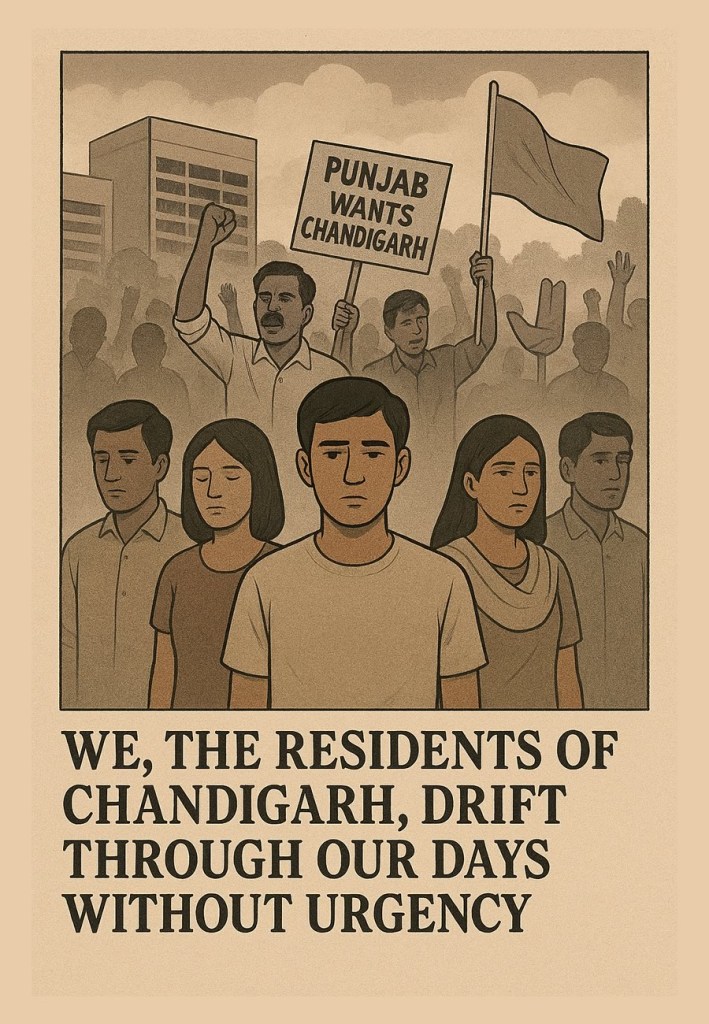
Chandigarh today stands in a curious political and psychological space. Administered directly by the Union government, the city is simultaneously claimed—politically, emotionally, and symbolically—by Punjab. The Chief Minister of Punjab, the Member of Parliament from Chandigarh, and nearly every major political party in Punjab openly advocate for Chandigarh’s inclusion in the state.
Yet amid this loud and persistent political chorus, the most striking silence comes from within Chandigarh itself.

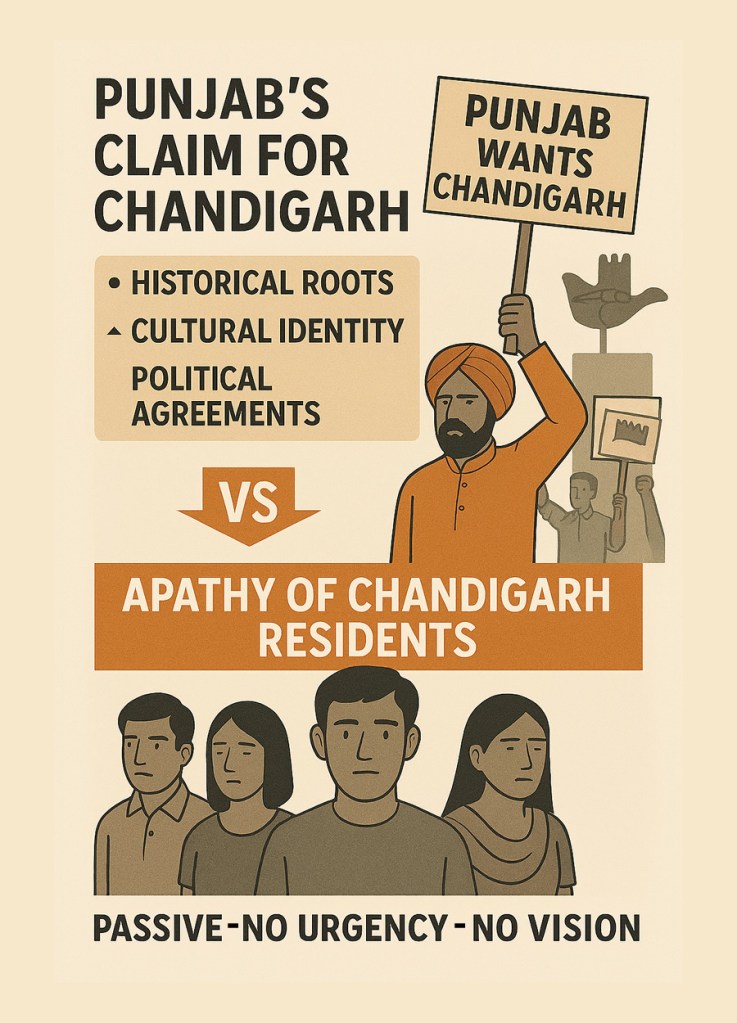
A City Without Urgency
For a city whose administrative future is constantly debated, Chandigarh’s residents display a remarkable lack of urgency. There are no sustained public movements, no citywide conversations, no visible mass engagement, and no visible public discourse asking a fundamental question: What do we want Chandigarh to become?
This absence is not neutrality—it is disengagement. It suggests not deliberation, but detachment. The city’s future is being negotiated in legislative assemblies, party offices, and press conferences elsewhere, while those who live in Chandigarh largely remain spectators.
Comfort as a Substitute for Agency
Chandigarh’s reputation as a well-planned, orderly, and relatively prosperous city has bred a particular kind of civic complacency. Good roads, efficient administration, and a high quality of life have replaced political participation as markers of success.
But comfort is not the same as control.
By outsourcing concern for the city’s future to governments and political actors outside the town, residents implicitly accept a diminished role for themselves. This quiet acceptance creates the impression that Chandigarh is less a community with aspirations and more a managed space—administered, adjusted, and reassigned as needed.
When Others Speak for You
The irony is sharp: Chandigarh’s political fate is passionately debated by leaders who do not live there, while those most affected by any change rarely articulate a collective position. The result is a vacuum—one quickly filled by louder, more motivated stakeholders.
In politics, silence is rarely interpreted as wisdom. More often, it is read as consent.
A Will Deferred Is a Future Decided Elsewhere
The lack of civic will among Chandigarh’s residents points to a deeper issue: the erosion of the idea that citizens are authors of their own future. When people stop imagining possibilities, stop demanding clarity, and stop asserting ownership, decisions do not pause—they move forward without them.
This is how destinies are quietly transferred.
Not through coercion or crisis, but through indifference.
The Cost of Not Wanting
Cities, like people, are shaped as much by what they desire as by what they tolerate. Chandigarh’s current posture—orderly, silent, and disengaged—risks reducing it to an administrative convenience rather than a living civic project.
If residents do not express what they want, they may soon find themselves living with what others have decided for them.
And by then, the silence will no longer be neutral. It will be irreversible.
“We, the residents of Chandigarh, drift through our days without urgency. The debates about our city’s future—whether it belongs to Punjab or remains under the Centre—echo around us, yet we remain unmoved. Our streets, our homes, our routines continue as if untouched by the political storm. We do not envision futures, nor do we claim destinies. We exist in a state of quiet apathy.”
“Punjab’s leaders speak passionately of Chandigarh’s rightful place in their state. They remind the nation that this city was built for Punjab, that its culture and history are inseparable from Punjabi identity. They argue that federal control strips Punjab of its capital, weakening its voice. Yet, as residents, we do not rise to join their chorus. We watch, detached, as decisions are made above us.”
“Perhaps our lack of will is itself a destiny. Without urgency, we surrender control. Without vision, we allow others to shape our future. Chandigarh, in this sense, is not ours to claim—it is theirs to contest. We remain shadows in our own city, drifting as Punjab and the Centre wrestle over ownership.”
“Khidya full gulab da, Chandigarh Punjab da.”
 CitiTimes