

Viksit Bharat Shiksha Adhishthan Bill, 2025: A Milestone in India’s Higher Education Reform
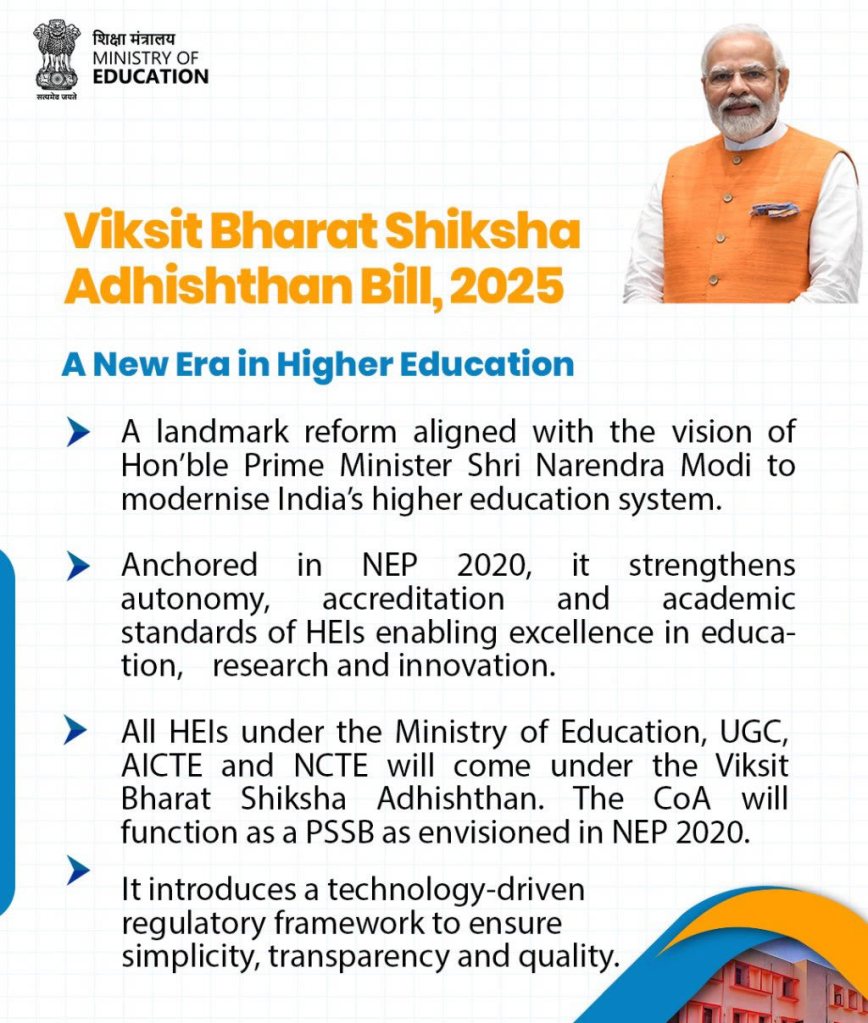
India’s higher education landscape is on the cusp of a historic transformation. On December 15, 2025, the Education Minister introduced the Viksit Bharat Shiksha Adhishthan Bill, 2025, in the Lok Sabha, aiming to unify and modernize the regulatory framework for universities and institutes of national importance. This landmark legislation promises to reshape governance, autonomy, and quality standards in line with the vision of the National Education Policy (NEP) 2020.
Why This Bill Matters
For decades, India’s higher education system has been overseen by multiple bodies, including the University Grants Commission (UGC), the All India Council for Technical Education (AICTE), and the National Council for Teacher Education (NCTE). While each played a crucial role, overlapping jurisdictions often led to bureaucratic hurdles and slowed innovation. The new Bill seeks to streamline this by creating a single apex body that ensures transparency, accountability, and efficiency.
Salient Features of the Bill
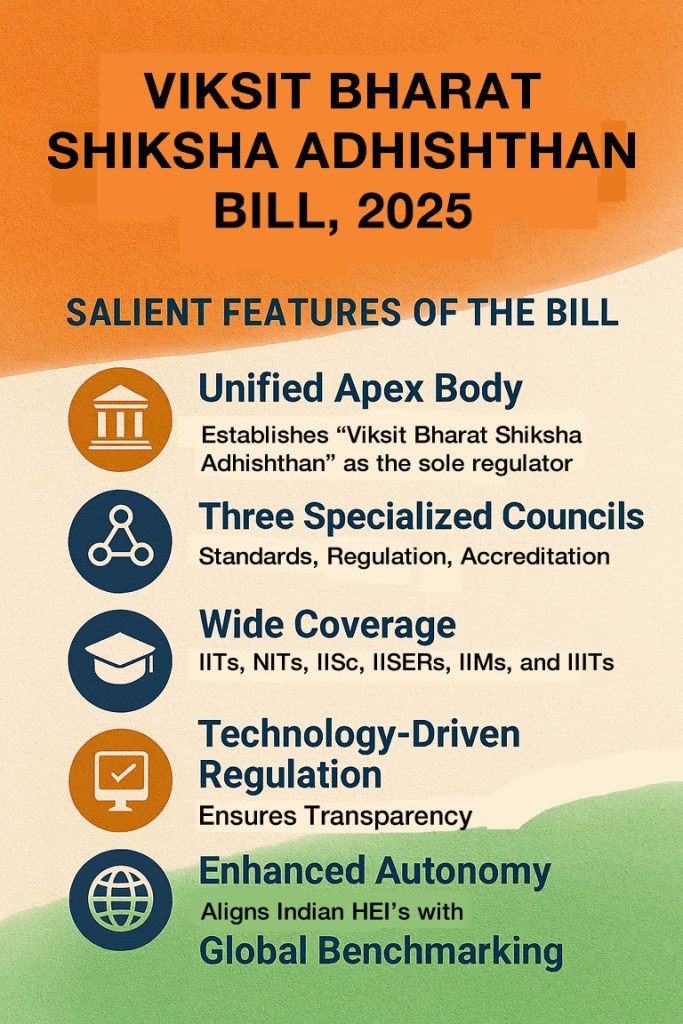
- Unified Apex Body: Establishes Viksit Bharat Shiksha Adhishthan as the sole regulator, subsuming UGC, AICTE, and NCTE.
- Three Specialized Councils:
- Standards Council – sets academic benchmarks.
- Regulation Council – oversees compliance and governance.
- Accreditation Council – ensures quality assurance.
- Wide Coverage: Applies to central universities, colleges, and institutes of national importance, including IITs, NITs, IISc, IISERs, IIMs, and IIITs.
- Technology-Driven Regulation: Introduces a faceless, single-window system for approvals and compliance, ensuring transparency and public disclosure.
- Enhanced Autonomy: Grants greater freedom to high-performing institutions to innovate, expand, and design multidisciplinary programs.
- Student-Centric Reforms: Focuses on holistic education, boosting Gross Enrollment Ratio (GER), and preparing students for global opportunities.
- Global Benchmarking: Aligns Indian higher education standards with international best practices.
Benefits for Institutions and Students
- Reduced Bureaucracy: Simplified compliance eliminates multiple layers of approvals.
- Greater Autonomy: Empowered institutions can innovate faster and expand globally.
- Improved Quality: Accreditation and benchmarking raise academic standards.
- Student Empowerment: Learners benefit from holistic, multidisciplinary education aligned with NEP 2020.
Challenges Ahead
While the Bill is ambitious, its success will depend on:
- Smooth transition from existing regulators.
- Balancing autonomy with accountability.
- Ensuring equitable implementation across diverse institutions.
Conclusion
The Viksit Bharat Shiksha Adhishthan Bill, 2025, is more than just a legislative reform—it is a bold step toward building a globally competitive, student-centric higher education system. By streamlining regulation, enhancing autonomy, and aligning with NEP 2020, India is poised to redefine its academic excellence and institutional reputation on the world stage.
“India’s higher education gets a bold new blueprint.”
 CitiTimes