
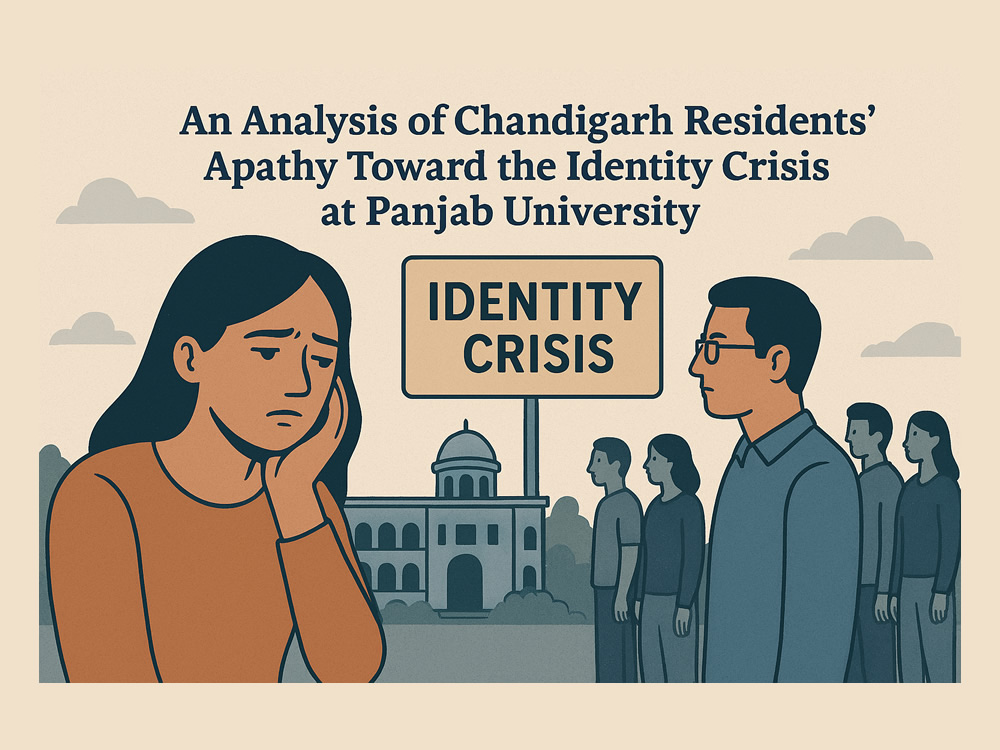
What Role Do the People of Chandigarh Play in the Panjab University Debate?
By CitiTimes Editorial Desk
As Panjab University stands at the center of renewed discussions over its governance and identity, the voices from Punjab grow louder — but Chandigarh remains largely quiet. Why? And what does that silence mean?
A University With Shared Roots — but Uneven Ownership
Panjab University (PU) in Chandigarh holds a unique place in India’s academic landscape. Founded as the successor to the pre-Partition University of the Punjab, it carries deep historical, cultural, and emotional significance for the people of Punjab. Even after the creation of Chandigarh as a Union Territory in 1966, PU continued under a shared governance structure involving:
- The Government of India
- The Government of Punjab
- The Chandigarh Administration
Its Senate, the University’s highest decision-making body, currently stands dissolved, and fresh Senate elections are pending. This vacuum has intensified debates about PU’s autonomy, identity, and the degree of influence various governments should wield.
Yet while Punjab has witnessed visible mobilisation — protests, statements by leaders, and public engagement — Chandigarh’s residents have not shown comparable involvement. This contrast raises an important question:
What is the role of Chandigarh’s people in this unfolding situation?
Chandigarh’s Connection: Administrative, Not Emotional
The people of Punjab feel a profound cultural attachment to PU. The University is regarded as a surviving fragment of Punjab’s pre-Partition heritage, and its autonomy is inextricably linked to regional pride and historical memory.
Chandigarh’s residents, however, relate to the institution in a different way.
As a Union Territory without its own state identity, Chandigarh primarily functions as an administrative capital rather than a cultural homeland. Its residents tend to view PU more as:
- A respected educational institution located in their city
- A campus where local students study
- An employer or community hub
But not as a symbol of regional identity.
This difference — historical versus functional attachment — shapes the intensity of public engagement.
Structural Limitations: Few Political Channels, Limited Stakeholding
Another key factor behind Chandigarh’s muted response lies in its political structure.
Punjab has a full-fledged state government, influential student organizations, and local leaders who frame PU’s governance as a matter of state autonomy and community pride.
Chandigarh has:
- No state legislature
- Limited political leadership
- Minimal direct authority over PU’s long-term governance
Even if residents wanted to play a more active part, institutional pathways to influence PU’s administration are limited or indirect.
This gap reinforces the sense that PU’s governance debate is being shaped elsewhere — primarily at the central (government) and provincial (Punjab) levels.
So Are Chandigarh’s Residents Merely Observers?
Not entirely — but their role is subtler and less politicized.
They are affected stakeholders in practical terms
Chandigarh residents send their children to PU and its affiliated colleges. Many work on the campus or depend on it as part of the local economy. Changes in governance, funding, or admissions policies can have a direct impact on them.
They participate indirectly through University structures
In normal circumstances, various constituencies, including alumni, teachers, and students residing in Chandigarh, vote in Senate elections. Although the Senate is currently vacant, Chandigarh’s academic community has historically contributed to its composition.
But they lack the emotional and political drivers that spur Punjab’s activism
Without a cultural claim, a legislative platform, or a sense of historical ownership, Chandigarh residents often view the issue as something for “higher authorities” to resolve.
Thus, they appear passive, even though they are not disconnected.
The Real Picture: A City That Lives With the Impact, but Not the Identity
If Punjab sees PU as an inheritance to protect, Chandigarh sees it as an institution to accommodate. The two positions are not contradictory; they are fundamentally different.
In essence:
- Punjab feels responsible for PU’s legacy.
- Chandigarh lives alongside PU as part of its civic life.
It positions the people of Chandigarh as situated participants rather than active protesters. They are neither outsiders nor deeply invested agitators, but rather stakeholders whose involvement tends to be pragmatic rather than political.
Chandigarh residents lack understanding of how the University operates.
Residents of Chandigarh have a limited understanding of how Panjab University functions. For instance, many people mistakenly believe that the University Registrar is self-appointed.
In reality, the Senate holds the authority to appoint the Registrar, who is responsible for overseeing various administrative functions. The Registrar, in turn, performs their duties under the direct supervision of the Vice-Chancellor, ensuring that their work aligns with the University’s broader goals and policies.
Governance & Identity
- Dual governance: Panjab University is unique in being funded and administered jointly by the Union Government of India and the Government of Punjab. This duality creates ambiguity about “ownership.”
- Senate vacuum: With no sitting Senate, the University’s highest decision-making body is inactive, leaving governance in a transitional state. It heightens tensions about who should have influence.
Chandigarh’s Position
- Affiliation: Colleges in Chandigarh are affiliated with Panjab University, so the city is academically tied to it.
- Administrative reality: Chandigarh is a Union Territory, directly governed by the central government, not Punjab. It means residents may not feel the same sense of “ownership” as Punjabis do.
- Indifference vs. detachment: The apparent lack of protest in Chandigarh doesn’t necessarily mean indifference—it may reflect:
- A perception that the issue is primarily between Punjab and the central government.
- A pragmatic stance: as long as colleges function, residents may not see immediate stakes.
- A civic identity: Chandigarh often positions itself as neutral ground, not belonging fully to Punjab or Haryana.
Role of Chandigarh Residents
- Not merely observers: While they may not be protesting, Chandigarh residents are stakeholders:
- Students, faculty, and affiliated colleges depend on the University’s stability.
- Civic leaders and intellectuals in Chandigarh can influence discourse about autonomy and governance.
- Potential influence: If Chandigarh’s academic community mobilizes, they could push for reforms—such as clearer governance structures or stronger central support.
- Current stance: By staying quiet, they are effectively allowing Punjab and the central government to negotiate without local pressure. Silence clearly shows a weak political position.
Interpretation
So, are they really just “merely observers”?
- In practice, yes—their current role is passive.
- In principle, no—they are stakeholders whose voices could hold significant weight if they chose to engage. Their neutrality provides them with potential leverage, but they are not currently utilizing it to their advantage.
Conclusion: Chandigarh residents hold a weak stance on the Panjab University dispute; they do not appear to be concerned about it.
The key question is whether the people of Chandigarh want to incorporate Panjab University into their civic identity or maintain a distance, thereby allowing Punjab to assert ownership. Currently, the people of Chandigarh seem to prefer staying quiet, inactive, and indifferent, thus enabling Punjab to claim ownership.
In a single line:
Chandigarh’s people are not merely observers; they are affected stakeholders who simply lack political channels, emotional investment, and a sense of ownership — which makes their role appear passive.
 CitiTimes