

QS World University Rankings: Asia 2026
QS Quacquarelli Symonds has released the QS World University Rankings: Asia 2026, revealing a region that is expanding in scale, diversifying in quality, and accelerating in research and international engagement.
The University of Hong Kong has risen to first place, overtaking Peking University, which now holds second place. Nanyang Technological University has climbed to a tie for third place alongside the National University of Singapore. This year’s rankings evaluate over 1,500 institutions across 25 higher education systems, including more than 550 new entrants—making it the most comprehensive assessment to date.
Mainland China leads in representation with 395 ranked universities, surpassing India, which has 294. Japan follows with 147 universities, and South Korea has 103. This year, Hong Kong SAR achieved its best performance ever, hosting five of Asia’s top ten universities.
Asia’s Top 10 Universities
- The University of Hong Kong
- Peking University
- Nanyang Technological University
- National University of Singapore
- Fudan University
- The Hong Kong University of Science and Technology
- City University of Hong Kong
- The Chinese University of Hong Kong
- Tsinghua University
- The Hong Kong Polytechnic University
Rankings Highlights
- India excels in research productivity and has a significant number of staff with PhDs.
- Malaysia stands out as one of the most improved higher education systems in this edition.
- South Korea showcases system-wide strength, matching China in the number of institutions in the top 20; 12 out of its 15 top 100 universities have shown improvement.
- Japan continues to be a benchmark for teaching quality and research impact, with the University of Tokyo ranked 26th.
- Taiwan has seen seven of its top ten universities rise in the rankings, led by National Taiwan University, which ranks 23rd.
- Thailand has dropped out of the top 50, but more universities have gained positions than lost them.
- Vietnam National University has emerged as the top institution in Vietnam.
- The top ten universities in Indonesia are improving in both academic and employer reputation, thereby enhancing the country’s regional influence.
- Pakistan, with 82 ranked universities, is the sixth most-represented higher education system in Asia.
- The Philippines achieves a milestone with 35 ranked universities, which is 11 more than in the previous edition.
- Kazakhstan dominates Central Asia, with all three of the subregion’s universities ranking in the top 100, while Uzbekistan’s leading universities have experienced significant improvements.
India in the QS Asia 2026 Rankings
This year’s QS Asia release is the largest ever, featuring 1,526 universities across 25 countries, including 557 new entrants. India has strengthened its status as one of the most represented higher education systems, with 294 Indian universities included in the rankings.
- Top Indian Performer: IIT Delhi is the leading institution in India, ranked 59th in Asia.
- Seven Indian universities are now listed among Asia’s Top 100, demonstrating gradual improvement in visibility and reputation.
- 36 Indian universities have improved their rankings since last year, with notable rises such as Sathyabama University, which climbed 111 positions to 262nd.
- However, QS analysts point out that India still lags behind East Asian countries like China, Singapore, and Hong Kong in terms of internationalization, including faculty diversity, global partnerships, and research networks.
China has now surpassed India as the most represented country in the Asia rankings, highlighting the increasing competition in the region.
QS Asia 2026 — India —Top 40
- Indian Institute of Technology Delhi (IITD), New Delhi, India
- Indian Institute of Science, Bangalore, India
- Indian Institute of Technology Madras (IITM), Chennai, India
- Indian Institute of Technology Bombay (IITB), Mumbai, India
- Indian Institute of Technology Kanpur (IITK), Kanpur, India
- Indian Institute of Technology Kharagpur (IIT-KGP), Kharagpur, India
- University of Delhi, New Delhi, India
- Chandigarh University, Mohali, India
- Indian Institute of Technology Roorkee (IITR), Roorkee, India
- Indian Institute of Technology Guwahati (IITG), Guwahati, India
- Jawaharlal Nehru University, New Delhi, India
- Birla Institute of Technology and Science, Pilani, India
- Vellore Institute of Technology (VIT), Vellore, India
- Shoolini University of Biotechnology and Management Sciences, Solan, India
- O.P. Jindal Global University (JGU) Sonepat, India
- UPES Dehradun, India
- Amity University Noida, India
- Lovely Professional University (LPU), Chaheru, India
- Jamia Millia Islamia, New Delhi, India
- Symbiosis International (Deemed University) Pune, India
- Anna University Chennai, India
- Manipal Academy of Higher Education, Manipal, Karnataka, India
- Savitribai Phule Pune University, Pune, India
- Jadavpur University, Kolkata, India
- University of Calcutta, Kolkata, India
- Banaras Hindu University Varanasi, India
- SRM Institute of Science and Technology, Chennai, India
- Indian Institute of Technology, Indore, India
- Indian Institute of Technology BHU Varanasi, Varanasi, India
- University of Mumbai, Mumbai, India
- University of Hyderabad, Hyderabad, India
- Thapar Institute of Engineering & Technology, Patiala, India
- Saveetha Institute of Medical And Technical Sciences, Tiruvallur, India
- Guru Gobind Singh Indraprastha University, New Delhi, India
- Sathyabama Institute of Science and Technology, Chennai, India
- Indian Institute of Technology Hyderabad, Sangareddy, India
- Panjab University, Chandigarh, India
- Aligarh Muslim University, Aligarh, India
- Bharathiar University, Coimbatore, India
- Kalinga Institute of Industrial Technology (KIIT), Bhubaneswar, India
Implications for Indian Higher Education
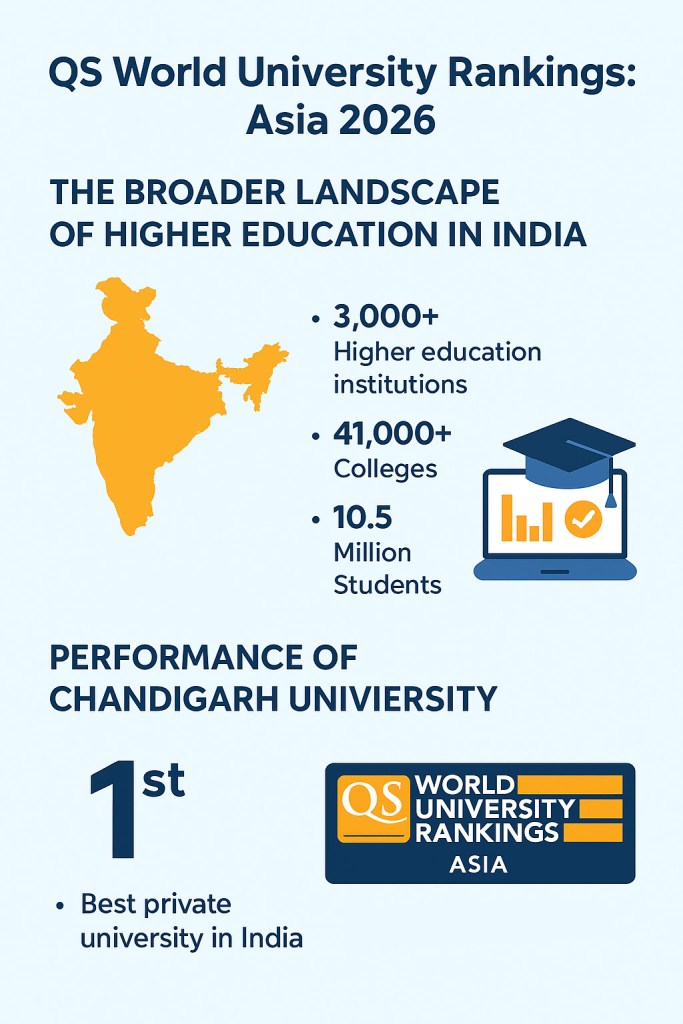
India’s extensive network of 294 universities highlights the country’s expanding presence in higher education. However, the data illustrates a mixed picture: while Indian institutions are increasingly recognized for their academic achievements and reputation among employers, global visibility and international collaboration remain limited.
The contrast between private universities and public universities exemplifies this situation. Newer private universities, such as Chandigarh University (CU), are rising in global rankings more swiftly due to their focus on international recruitment and partnerships. In contrast, public institutions, such as Panjab University (PU), are rooted in traditional academic strengths, but they need to enhance their global engagement to improve their standing.

Chandigarh University (CU) has been recognized as the highest-ranked private university in India for the third consecutive year and is currently positioned among Asia’s top 110 universities.
Source: QS
 CitiTimes