
Centre Overhauls Panjab University Governance: Senate and Syndicate Reconstituted
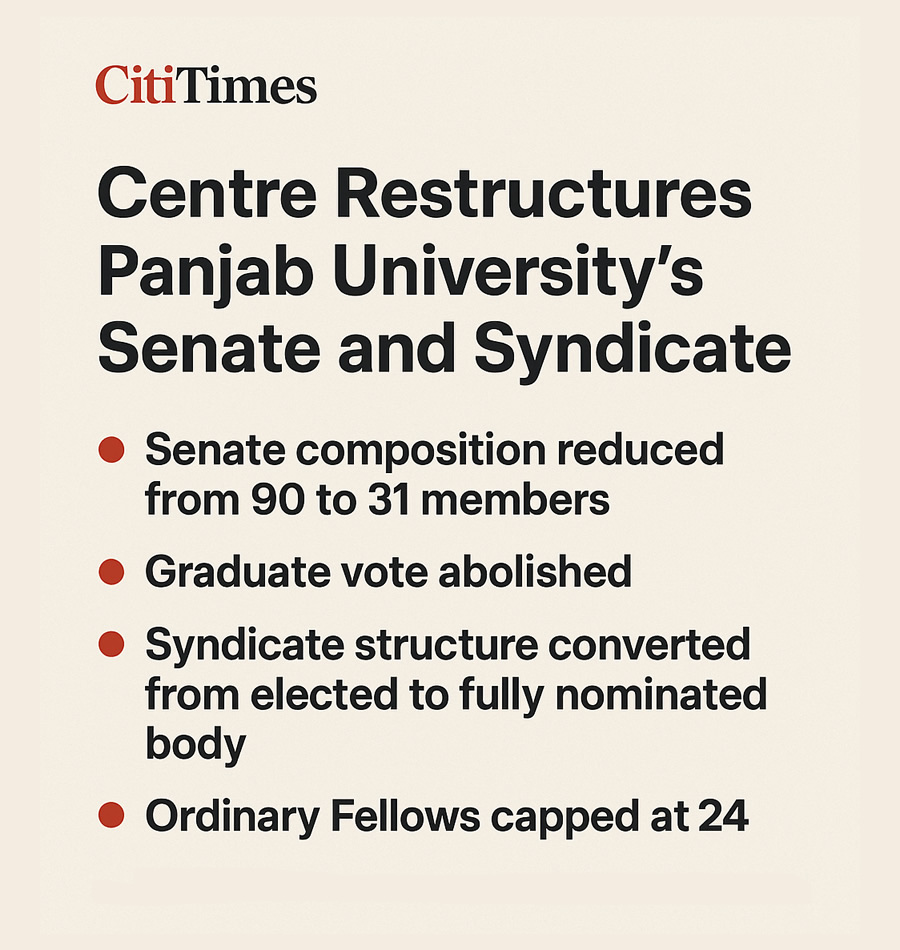
In a significant policy shift, the Government of India has restructured the governance framework of Panjab University in Chandigarh. This change involves modifying the composition of the Senate and Syndicate, which are the university’s two highest decision-making bodies. A notification issued by the Ministry of Education on October 28, 2025, conveys the most comprehensive administrative change at the university in nearly sixty years.

What Has Changed
The new notification has significantly altered the university’s governance structure.
- Senate composition reduced:
The Senate — traditionally the supreme governing body of Panjab University — will now have 31 members, down from nearly 90 earlier.
- End of graduate constituency:
The long-standing system allowing university graduates to elect Senate members has been abolished. It means the “graduate vote“, which allowed thousands of alumni to participate in university elections, is now discontinued.
- Syndicate restructured:
The Syndicate, acting as the executive arm of the Senate, will now primarily consist of nominated and ex officio members instead of elected representatives. This group will include officials from the Chandigarh Administration, university authorities, and nominees appointed by the Vice-Chancellor.
- Inclusion of new ex officio members:
For the first time, representatives such as the Member of Parliament from Chandigarh and the UT Chief Secretary will serve as ex officio members of the Senate.
Official Rationale
Government sources indicate that the restructuring aims to enhance efficiency, ensure accountability, and align with national standards for higher education. This initiative follows the recommendations of a committee established in 2021 to review university governance systems.
The notification is based on the powers granted by the Panjab University Act (1947) and the Punjab Reorganisation Act (1966). These legislations establish the university’s administrative framework as a Central institution serving both Punjab and Chandigarh.
Criticism and Concerns
The decision has generated significant reactions in Punjab’s political and academic circles.
The Aam Aadmi Party (AAP), Congress, and Shiromani Akali Dal (SAD) have condemned the move, claiming that it undermines Punjab’s rights and threatens the university’s democratic character. Critics argue that this change centralizes power and diminishes stakeholder representation, particularly that of alumni and elected faculty.
Supporters of the change argue that it could lead to more efficient decision-making and improved coordination with national education policies and funding frameworks.
Why It Matters
Panjab University, established in 1882 in Lahore, now in Pakistan, is one of the oldest universities in India. Its governance model, which features a Senate elected by graduates and faculty, was regarded as a model of participatory academic democracy.
Observers view the abolition of elections and the shift to nominations as a significant turning point in Indian university governance, one that could redefine the relationship between academic autonomy and government oversight.
What’s Next
The changes will take effect immediately.
The first reconstituted Senate and Syndicate will be announced soon, followed by the notification of new rules of business.
Political parties and alumni groups have expressed concerns about potential legal challenges to the restructuring, arguing that it contradicts the spirit of the Panjab University Act and the principles of academic self-governance.
Conclusion
The restructuring of Panjab University’s Senate and Syndicate signifies the end of an era that prioritized electoral representation in university governance. Whether this change will result in greater efficiency or diminished autonomy remains uncertain.
As the university community seeks more clarification, one thing is clear: this decision will influence the future of higher education governance, not only in Chandigarh but throughout India.
Source: CitiTimes Desk
 CitiTimes