
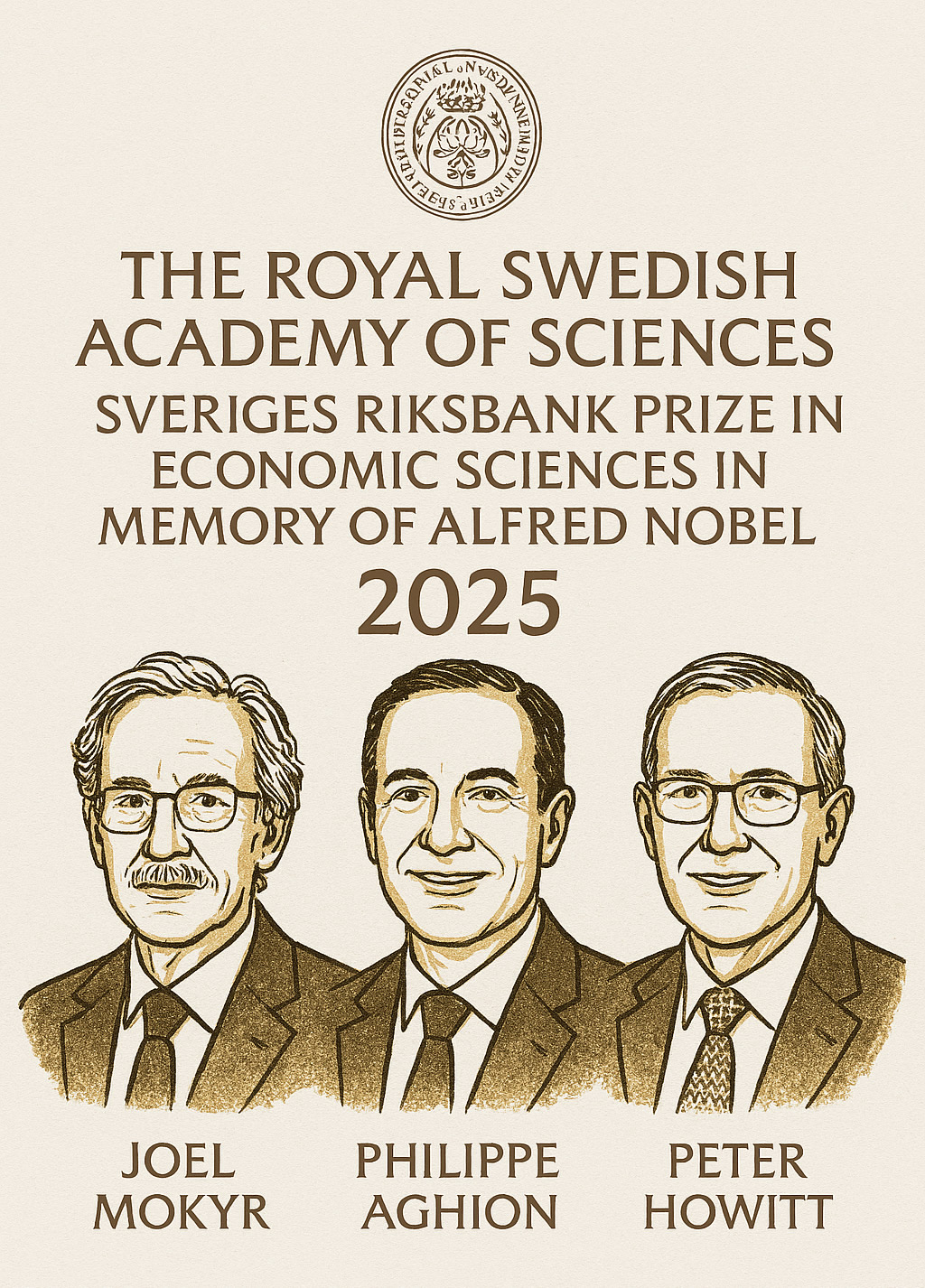
The Sveriges Riksbank Prize in Economic Sciences in Memory of Alfred Nobel for the year 2025.
October 13, 2025
The Royal Swedish Academy of Sciences has awarded the Sveriges Riksbank Prize in Economic Sciences in Memory of Alfred Nobel for 2025 to Joel Mokyr, Philippe Aghion, and Peter Howitt.
They are recognized “for explaining innovation-driven economic growth.”
The Prize is divided as follows:
- One half goes to Joel Mokyr from Northwestern University, Evanston, IL, USA, “for identifying the prerequisites for sustained growth through technological progress.”
- The other half is jointly awarded to Philippe Aghion from Collège de France and INSEAD, Paris, France, and The London School of Economics and Political Science, UK, and Peter Howitt from Brown University, Providence, RI, USA, “for their theory of sustained growth through creative destruction.”
They demonstrate how new technology can drive sustained growth.
For the past two centuries, the world has experienced sustained economic growth for the first time in history. This growth has lifted millions of people out of poverty and laid the foundation for our prosperity. This year’s Nobel laureates in economic sciences, Joel Mokyr, Philippe Aghion, and Peter Howitt, explain how innovation serves as the driving force behind further progress.
Read the remainder of the announcement:
“Technology advances rapidly and impacts us all, with new products and production methods replacing older ones in a continuous cycle. This innovation is the foundation for sustained economic growth, which leads to improvements in the standard of living, health, and overall quality of life for people around the globe.
“However, this was not always the case. In fact, stagnation was the norm for much of human history. Despite occasional significant discoveries that improved living conditions and increased incomes, growth consistently leveled off over time.
“Historian Joel Mokyr used historical sources to investigate the causes behind the emergence of sustained growth as the new standard. He demonstrated that for innovations to succeed in a self-generating process, we need not only to know that something works but also to have scientific explanations for why it works. This understanding was often missing before the Industrial Revolution, making it challenging to build upon discoveries and inventions. He also emphasized the importance of a society that is open to new ideas and encourages change.
“Philippe Aghion and Peter Howitt explored the mechanisms behind sustained growth as well. In a 1992 article, they developed a mathematical model for what is known as creative destruction. When a new and better product enters the market, companies selling the older products suffer losses. The innovation is considered innovative because it offers something novel, but it is also destructive because the company whose technology becomes outdated is outcompeted.
“In various ways, these researchers illustrate how creative destruction creates conflicts that must be managed constructively. If not, innovation can be hindered by established companies and interest groups that fear losing their advantages.
“’The work of the laureates demonstrates that we cannot take economic growth for granted. We must support the mechanisms that enable creative destruction to prevent a return to stagnation,’ stated John Hassler, Chair of the Committee for the Prize in Economic Sciences.“
Source: The Royal Swedish Academy of Sciences
 CitiTimes