
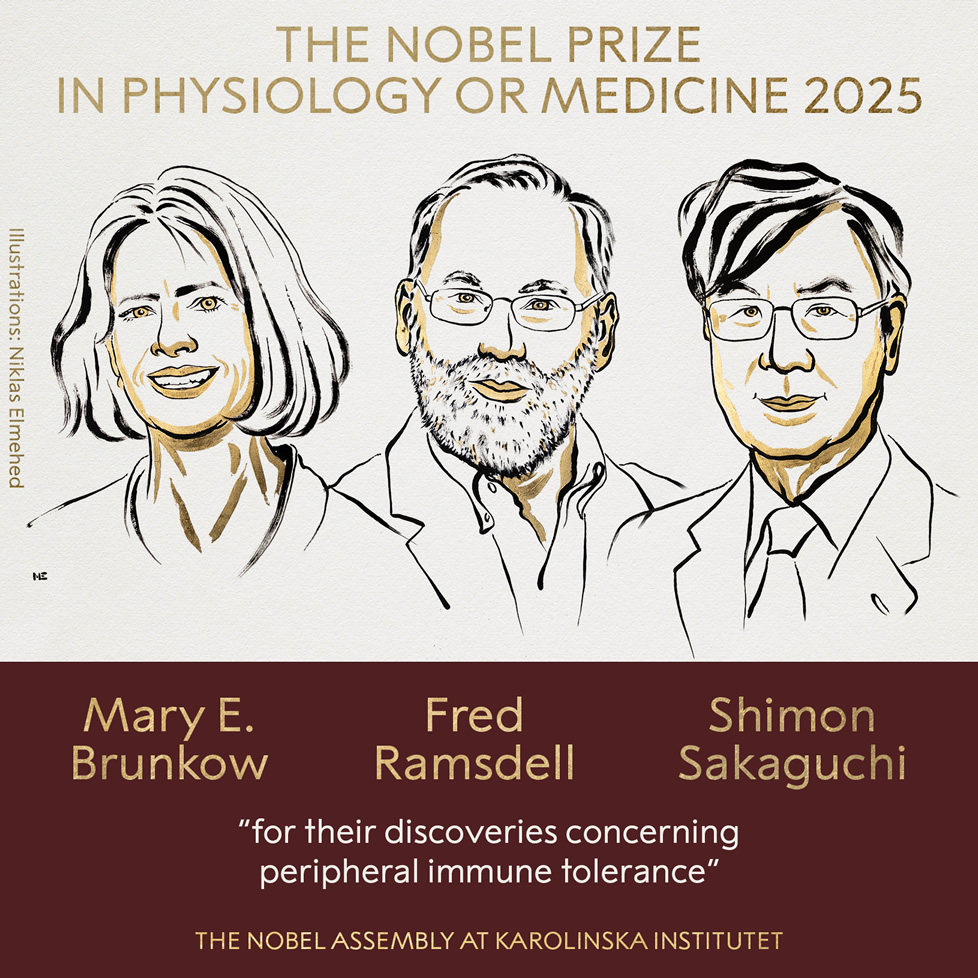
The Nobel Prize in Physiology or Medicine 2025
October 6, 2025.
The Nobel Assembly at the Karolinska Institutet has decided to award the 2025 Nobel Prize in Physiology or Medicine to:
- Mary E. Brunkow, Institute for Systems Biology, Seattle, USA
- Fred Ramsdell, Sonoma Biotherapeutics, San Francisco, USA
- Shimon Sakaguchi, Osaka University, Osaka, Japan
This award is given “for their discoveries concerning peripheral immune tolerance.”
They discovered how to regulate the immune system.
The immune system must be adequately regulated to prevent it from attacking the body’s own organs. Mary E. Brunkow, Fred Ramsdell, and Shimon Sakaguchi were awarded the Nobel Prize in Physiology or Medicine in 2025 for their pivotal work on peripheral immune tolerance, which protects the body from autoimmune harm.
Every day, our immune system defends against numerous invading microbes, some of which resemble human cells. The key question is how the immune system distinguishes between threats and the body itself.
The laureates identified regulatory T cells, which play a crucial role in preventing the body from launching immune attacks. “Their discoveries have been crucial for understanding the immune system and why serious autoimmune diseases are not more common,” says Olle Kämpe, chair of the Nobel Committee.
In 1995, Sakaguchi challenged prevailing beliefs by showing that immune tolerance involves more than just eliminating harmful cells in the thymus. He uncovered a new class of immune cells that safeguard against autoimmune diseases.
In 2001, Brunkow and Ramsdell explained why a specific mouse strain was susceptible to autoimmune diseases due to a mutation in the Foxp3 gene. They also linked mutations in this gene to the human autoimmune disorder IPEX.
Two years later, Sakaguchi connected these discoveries, proving that the Foxp3 gene regulates the development of regulatory T cells, which help maintain tolerance to our own tissues.
These findings have launched the field of peripheral tolerance and prompted the development of new treatments for cancer and autoimmune diseases, with several now in clinical trials.
Source: The Nobel Assembly at Karolinska Institutet
 CitiTimes