

Chandigarh does not have the authority to engage directly with UNESCO.
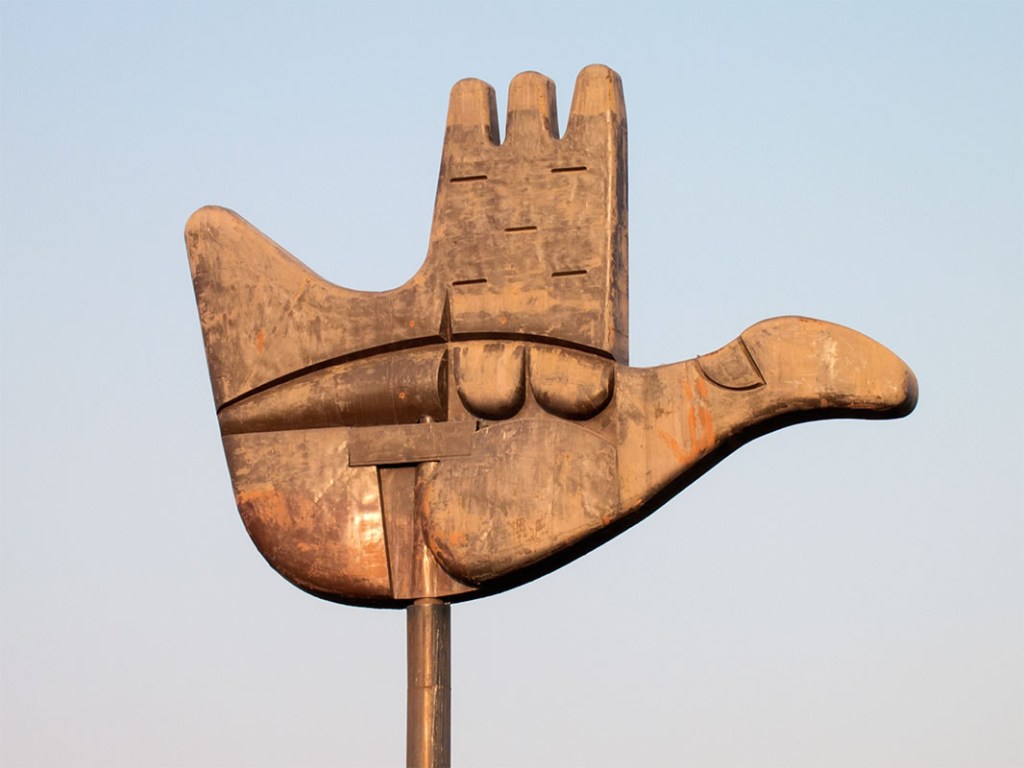
Chandigarh, India, September 28, 2025 — Recently, some local newspapers in Chandigarh incorrectly reported that officials from the Chandigarh Administration had met with representatives from UNESCO in Geneva to submit a proposal for consideration. The information given was not entirely accurate. The Times of India has since elucidated that, in fact, Chandigarh officials participated in discussions with representatives from six partner countries: Argentina, Belgium, France, Germany, Japan, and Switzerland.
The Chandigarh Capitol Complex is part of a serial nomination that includes 17 properties across seven countries: India, France, Switzerland, Belgium, Germany, Japan, and Argentina. It is crucial to note that unanimous consent from all seven countries is required before any proposals can be submitted to UNESCO. This unanimous agreement is essential because any changes made to one property can impact the heritage status of all the other properties within the serial nomination.
- UNESCO deals only with State Parties (i.e., Sovereign Countries that have ratified the World Heritage Convention).
- India, as a State Party, is represented at UNESCO through the Government of India—specifically the Ministry of Culture and its nodal body, the Archaeological Survey of India (ASI).
- The Chandigarh Administration is responsible for local site management of the Capitol Complex (maintenance, planning, compliance with guidelines, etc.), but it does not directly represent India before UNESCO.
- When any proposal or modification concerning the Capitol Complex is to be placed before UNESCO, the Chandigarh Administration prepares the plan and heritage impact documentation, but it is formally routed through the Government of India (Ministry of Culture) to UNESCO’s World Heritage Centre.
- In conclusion, the Chandigarh Administration plays a crucial role in providing input and formulating proposals; however, it does not possess the authority to submit these documents independently. The authority to approve and submit all proposals rests solely with the Government of India.
- Furthermore, since the Chandigarh Capitol Complex is a part of the serial nomination of 17 properties located in seven countries—India, France, Switzerland, Belgium, Germany, Japan, and Argentina—unanimous consent from all seven parties is required before any proposals can be submitted to UNESCO.
Background: Capitol Complex & UNESCO Status
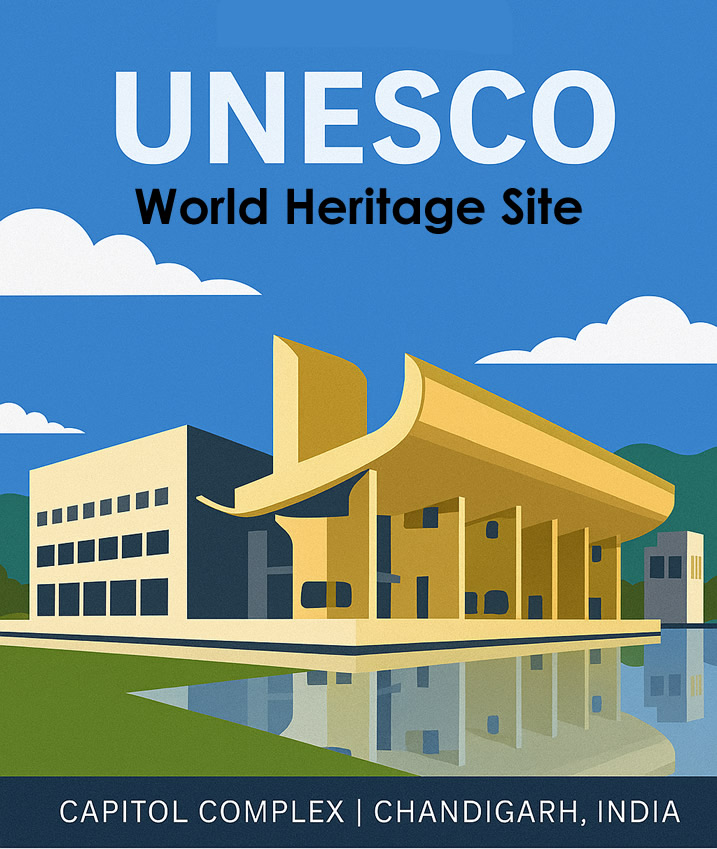
- The “Architectural Work of Le Corbusier, an Outstanding Contribution to the Modern Movement” is a transnational serial property that was inscribed by UNESCO in 2016. It is recognized for its Outstanding Universal Value (OUV) as a modernist architectural masterpiece.
- This designation includes 17 properties designed by Le Corbusier, located across seven countries: India, France, Switzerland, Belgium, Germany, Japan, and Argentina. The Capitol Complex in Chandigarh, India, is one such property.
Highlights from the Geneva Meeting (September 2025)
- In early September 2025, the Chandigarh administration held a meeting in Geneva with partner countries involved in a serial nomination to discuss proposed developments in the Capitol Complex. Here are some key points from the meeting:
- The six other countries participating, in addition to India, are Argentina, Belgium, France, Germany, Japan, and Switzerland.
- A primary focus of the meeting was the expansion plan for the Punjab and Haryana High Court. This plan involves the addition of new courtrooms, chambers for advocates, administrative offices, parking facilities, and more.
- It is essential to address heritage concerns in this plan, as any changes to the Complex could impact its Outstanding Universal Value (OUV) as recognized by UNESCO.
Key Proposals Discussed
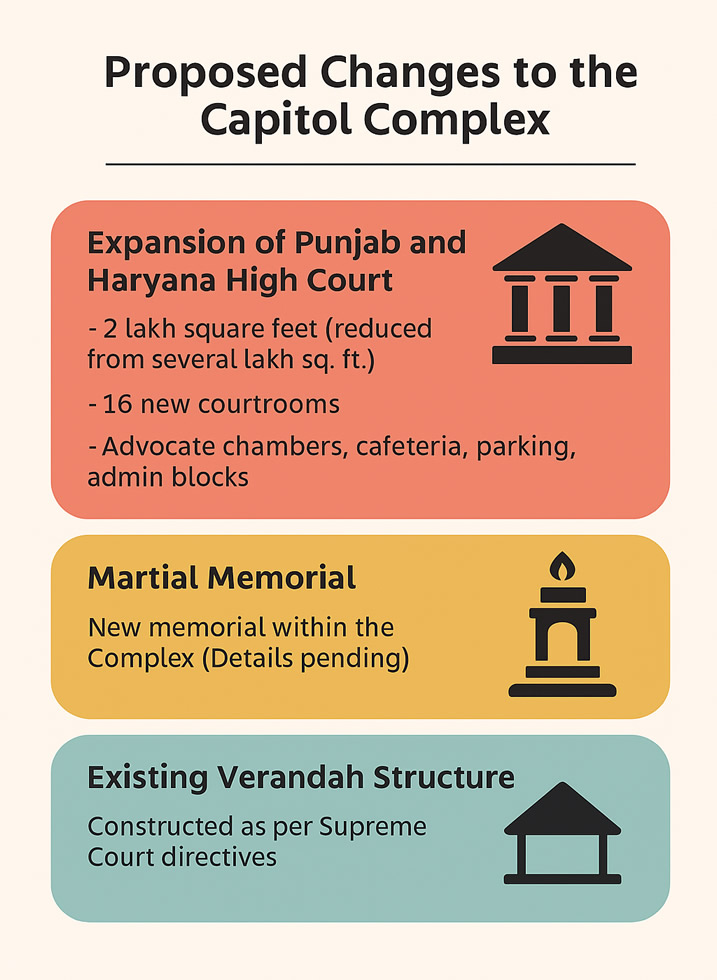
1. Expansion of the Punjab and Haryana High Court:
- The original plan proposed several lakh square feet of new construction.
- The revised plan now limits the expansion to 2 lakh square feet, which will include:
– 16 new courtrooms
– Advocate chambers
– A cafeteria
– Parking facilities
– Administrative blocks
All additions will be constructed at a suitable distance from heritage structures.
2. Martial Memorial:
– A new memorial is proposed to be built within the Complex.
3. Existing Verandah Structure:
– The administration stated that its construction adhered to Supreme Court directives, addressing concerns raised by UNESCO and ICOMOS (International Council on Monuments and Sites).
Next Steps
– Chandigarh has been asked to prepare a Detailed Report that outlines all proposed changes and assesses their potential impact on the site’s heritage value.
– This report will be shared with partner countries for feedback before it is submitted to UNESCO.
– The administration emphasized the importance of a balanced approach to ensure that modern infrastructure needs are met without compromising the architectural integrity of the site.
Key Constraints and Conditions
- The Capitol Complex stands as a vibrant administrative hub, attracting hundreds of visitors each day. Its grand architecture and historic significance draw people from all walks of life, creating a unique blend of activity and reverence. Balancing its dual role as a functional living space for government officials and a revered heritage site demands meticulous planning and fostered international collaboration. This intricate management ensures the preservation of its historical value while accommodating the modern needs of governance and public engagement.
- Since this is a serial transnational listing, all partner countries must agree to any proposed changes that could affect the heritage value. Any proposal that impacts preservation efforts must be submitted to UNESCO only after consulting all parties involved and obtaining their approval.
- The proposed plan has been revised to better align with heritage guidelines. For example, it ensures that any new structures are placed at a sufficient distance from existing heritage buildings, minimizes the construction footprint, and considers the visual impact on the surroundings.
- There is a “blue line” marked by UNESCO that indicates the permitted envelope for new construction. The revised plan aims to adhere to this boundary.
Stakes and Potential Consequences
- If the proposed changes jeopardize the heritage value or overall integrity of the Chandigarh Capitol Complex, UNESCO will firmly reject the proposals or necessitate significant modifications to them. Previous undertakings, including the development of the verandah and the construction of the basement car park, have been paused to ensure that a comprehensive heritage impact assessment is carried out. This assessment is crucial to safeguarding the cultural and historical significance of this iconic site.
- All partner countries must diligently uphold these crucial standards without exception. The potential loss of heritage status for the Capitol Complex would not only tarnish India’s global reputation but also put at risk the integrity of the Outstanding Universal Value that connects and unites all the nominated sites. This shared value encompasses remarkable cultural and historical significance across the six other countries involved in this serial nomination: Argentina, Belgium, France, Germany, Japan, and Switzerland. Safeguarding this status is essential to preserving the rich tapestry of heritage that these sites collectively represent.
Sources: Agencies; UNESCO
— CitiTimes Editor holds UNESCO-IIEP certification and helps promote the UNESCO Creative Cities Network.
 CitiTimes