

The President of India presents the Swachh Survekshan (Cleanliness Survey) Awards.


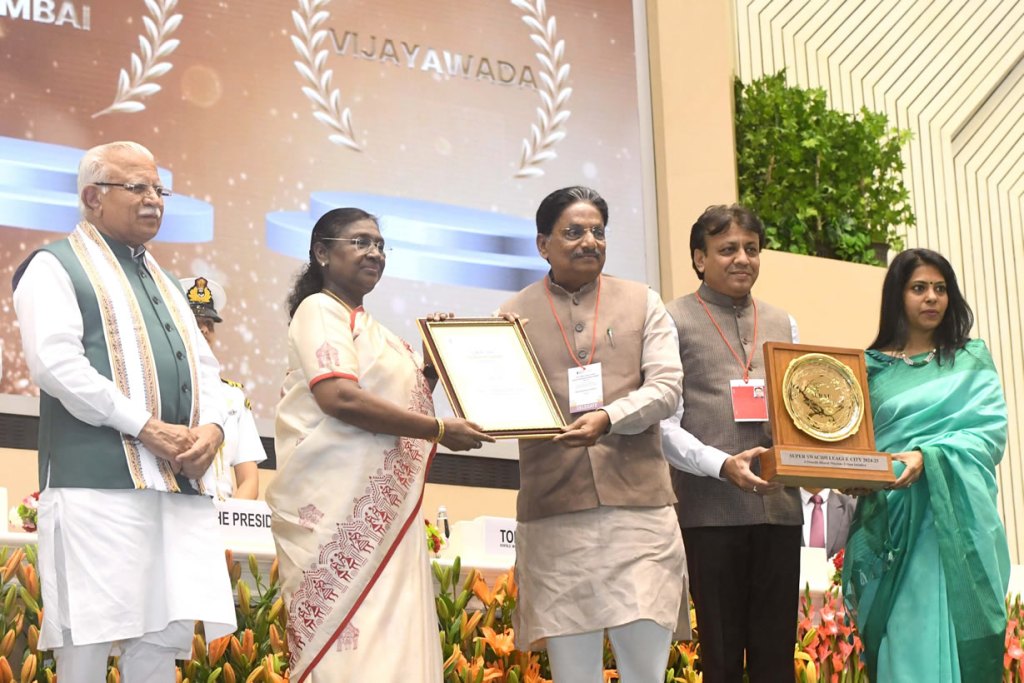
New Delhi, India, July 17, 2025 — The President of India, Droupadi Murmu, presented the Swachh Survekshan (Cleanliness Survey) awards at a function organized by the Ministry of Housing and Urban Affairs in New Delhi on July 17, 2025.
The President noted that Swachh Survekshan has been a successful initiative in evaluating and promoting the efforts of our cities toward cleanliness. She expressed her satisfaction that the world’s largest cleanliness survey, conducted by the Ministry of Housing and Urban Affairs, was for the year 2024. This survey saw participation from various stakeholders, including state governments, urban bodies, and approximately 140 million citizens.
The President stated that our cultural and spiritual consciousness has long emphasized the importance of cleanliness. Maintaining clean homes, places of worship, and surroundings has been an integral part of our lifestyle since ancient times. The Father of the Nation, Mahatma Gandhi, famously said, “Cleanliness is next to godliness.” He viewed cleanliness as the foundation of religion, spirituality, and civic life. The President also mentioned that she began her journey in public service by focusing on cleanliness initiatives. As the Vice President of the Notified Area Council, she used to visit different wards daily to supervise cleanliness efforts.
The President stated that minimizing waste by using fewer resources and reusing them for the same or different purposes has always been a part of our lifestyle. The basic principles of a circular economy, along with the systems of reduce, reuse, and recycle, are modern and widespread interpretations of our ancient way of living. For instance, the traditional lifestyles of tribal communities are simple; they utilize fewer resources and maintain harmony with the environment and weather, collaborating closely with other community members. They do not waste natural resources. We could strengthen modern systems of circularity by adopting such behaviors and traditions.
The President stated that the first and most crucial step in the waste management value chain is source segregation. All stakeholders and households must pay close attention to this step. Zero-waste communities are setting excellent examples.
The President praised the School Level Assessment initiative, which aims to instill in students a core value of cleanliness. She mentioned that it would yield very beneficial and far-reaching results.
The President acknowledged that managing plastic and electronic waste, as well as the pollution they cause, is a significant challenge. However, with the right efforts, we can considerably reduce plastic emissions in the country. In 2022, the central government implemented a ban on certain single-use plastic items. Additionally, the government introduced guidelines for Extended Producer Responsibility regarding plastic packaging that same year. It is the duty of all stakeholders—producers, brand owners, and importers—to ensure that these guidelines are fully adhered to.
The President emphasized that cleanliness efforts have economic, cultural, and geographical dimensions. She expressed her confidence that all citizens would wholeheartedly participate in the Swachh Bharat Mission. She stated that with strong, well-planned resolutions, India aims to be one of the cleanest countries in the world by the year 2047.
Source: President’s Secretariat
 CitiTimes