

NASA is set to welcome its fourth private astronaut mission to the International Space Station.
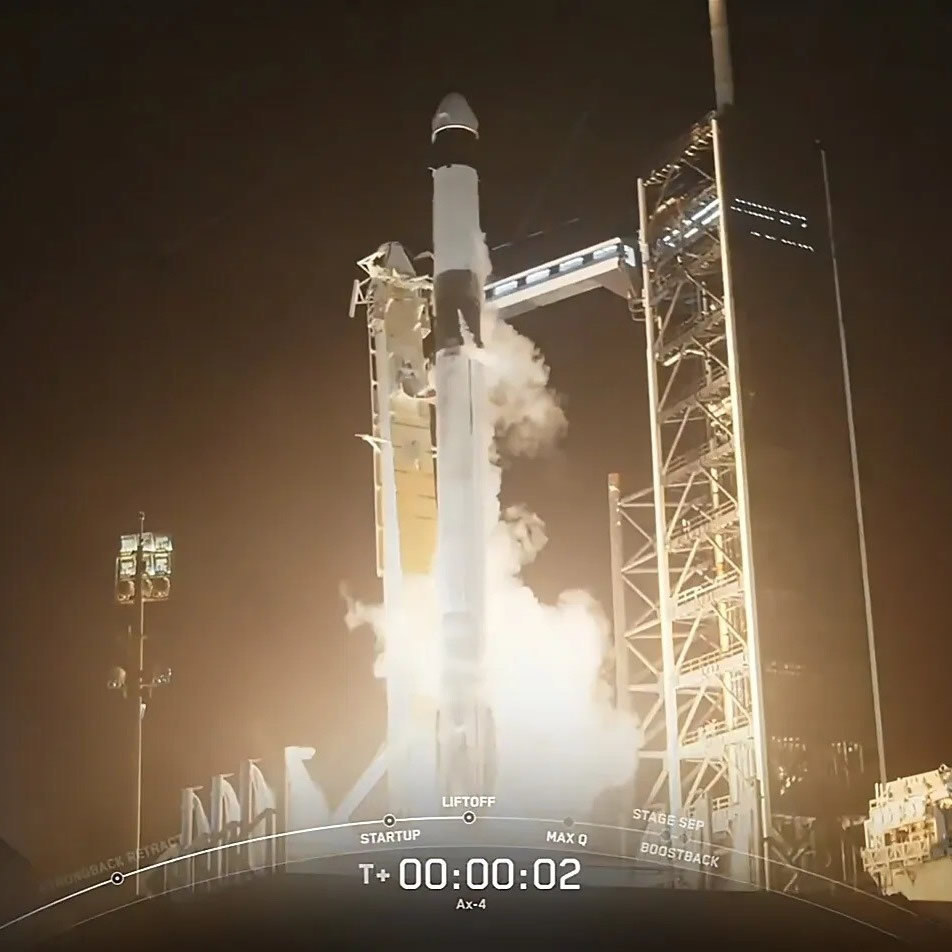
WASHINGTON, June 25, 2025 — In a bid to enhance access to space, four private astronauts are currently in orbit after the successful launch of the fourth entirely private astronaut mission to the International Space Station.
A SpaceX Dragon spacecraft launched at 2:31 a.m. EDT on Wednesday from Launch Complex 39A at NASA’s Kennedy Space Center in Florida. The spacecraft is carrying the crew members for Axiom Mission 4:
- Peggy Whitson, a former NASA astronaut and the director of human spaceflight at Axiom Space, serving as commander.
- Shubhanshu Shukla, an astronaut and pilot from the Indian Space Research Organisation (ISRO).
- Sławosz Uznański-Wiśniewski, a project astronaut from the European Space Agency (ESA) representing Poland, serving as a mission specialist.
- Tibor Kapu, an astronaut from HUNOR (Hungarian to Orbit) representing Hungary.
“Congratulations to Axiom Space and SpaceX on a successful launch,” stated NASA’s acting Administrator, Janet Petro. “Under President Donald Trump’s leadership, America has expanded international participation and enhanced commercial capabilities in low Earth orbit. U.S. industries are enabling astronauts from India, Poland, and Hungary to return to space for the first time in over forty years. It is a powerful example of American leadership uniting nations in the pursuit of science, discovery, and opportunity.”
A groundbreaking collaboration between NASA and ISRO made it possible for Axiom Mission 4 to honor a pivotal commitment set forth by President Trump and Indian Prime Minister Narendra Modi to send the first ISRO astronaut to the International Space Station. This historic mission marks a significant milestone in international space cooperation. The two space agencies are engaged in a total of five comprehensive scientific investigations that explore a range of research areas, along with two innovative in-orbit demonstrations aimed at advancing science, technology, engineering, and mathematics (STEM). NASA and ISRO have cultivated a strong and enduring partnership over the years, rooted in a shared vision to push the boundaries of scientific knowledge and foster collaboration in space exploration. This partnership not only enhances the capabilities of both agencies but also paves the way for future endeavors in the ever-evolving field of space exploration.
This mission illustrates the success achieved through collaboration between NASA’s international partners and American commercial space companies.
Live coverage of the spacecraft’s arrival will begin at 5 a.m. on Thursday, June 26, on NASA+. You can learn how to watch NASA content through various platforms, including social media.
The spacecraft is scheduled to autonomously dock at approximately 7 a.m. at the space-facing port of the Harmony module on the space station.
Once aboard the station, Expedition 73 crew members, including NASA astronauts Nicole Ayers, Anne McClain, and Jonny Kim, JAXA (Japan Aerospace Exploration Agency) astronaut Takuya Onishi, and Roscosmos cosmonauts Kirill Peskov, Sergey Ryzhikov, and Alexey Zubritsky will welcome the astronauts.
The crew is scheduled to remain at the space station, conducting microgravity research, educational outreach, and commercial activities for approximately two weeks before returning to Earth and splashing down off the coast of California.
The International Space Station serves as a launchpad for developing a low Earth economy. NASA aims to create a robust economy beyond Earth, allowing the agency to purchase services as one of many customers to fulfill its science and research goals in microgravity. Their commercial strategy for low Earth orbit ensures that the government receives reliable and safe services at a lower cost. This approach not only empowers U.S. industry but also allows NASA to concentrate on Artemis missions to the Moon in preparation for future Mars exploration. Additionally, it enables the agency to utilize low Earth orbit as a training and testing ground for deep space missions.
Source: NASA
 CitiTimes