

- Chandigarh, in India, is self-styled as “The City Beautiful” but is not a UNESCO World Heritage City.
New Delhi, India, February 3, 2025 — Mr. Manish Tewari, the Member of Parliament for Chandigarh, formally asked the Minister of Culture about the city’s status as a UNESCO World Heritage city.
In response, the Minister of Culture and Tourism, Mr. Gajendra Singh Shekhawat, provided the following reply:
UNESCO has not designated Chandigarh as a World Heritage City.
Nonetheless, the Chandigarh Capitol Complex was inscribed as a UNESCO Transnational World Heritage Property in 2016 under “The Architectural Work of Le Corbusier: An Outstanding Contribution to the Modern Movement.” This Property encompasses contributions from seven nations: Argentina, France, Switzerland, Belgium, Germany, Japan, and India.
According to the UNESCO Operational Guidelines of 2024, any World Heritage property, including World Heritage Cities, must meet one or more of the outlined criteria.
- Cultural Criteria for UNESCO World Heritage Properties: The criteria for recognizing significant cultural and historical sites include the following:
- The site must represent a masterpiece of human creative genius.
- It should demonstrate an essential interchange of human values over time or within a specific cultural area, particularly relating to developments in architecture, technology, monumental arts, town planning, or landscape design.
- The site must provide a unique testimony to a cultural tradition or civilization, whether it is still living or has disappeared.
- It should be an outstanding example of a building type, architectural ensemble, or landscape that illustrates significant stages in human history.
- The site must exemplify a traditional human settlement, land use, or sea use that reflects a culture (or cultures) and showcases human interaction with the environment, especially in cases where it has become vulnerable to irreversible changes.
- It should have a direct or tangible association with significant events, living traditions, ideas, or beliefs, and artistic and literary works of outstanding universal significance.
In response to Mr. Tewari’s inquiry, Mr. Shekhawat presented UNESCO’s list of 335 cities recognized as World Heritage Cities. This official list includes two cities from India: (1) the Historic City of Ahmedabad, renowned for its rich tapestry of architectural styles and vibrant heritage, and (2) Jaipur City in Rajasthan, celebrated for its majestic palaces and unique urban planning that reflect the grandeur of India’s royal past.
- Chandigarh calls itself “The City Beautiful,” although it has not received formal recognition as such from any authoritative body. Consequently, this self-designation does not qualify it as a World Heritage City.
Sources: Lok Sabha; Ministry of Culture, Government of India
- Jaipur was awarded the UNESCO World Heritage City certificate in 2020.

In 2020, Ms. Audrey Azoulay, the Director-General of UNESCO, awarded the UNESCO World Heritage City certificate to Jaipur, the “Pink City” at Albert Hall, Jaipur, Rajasthan, India.
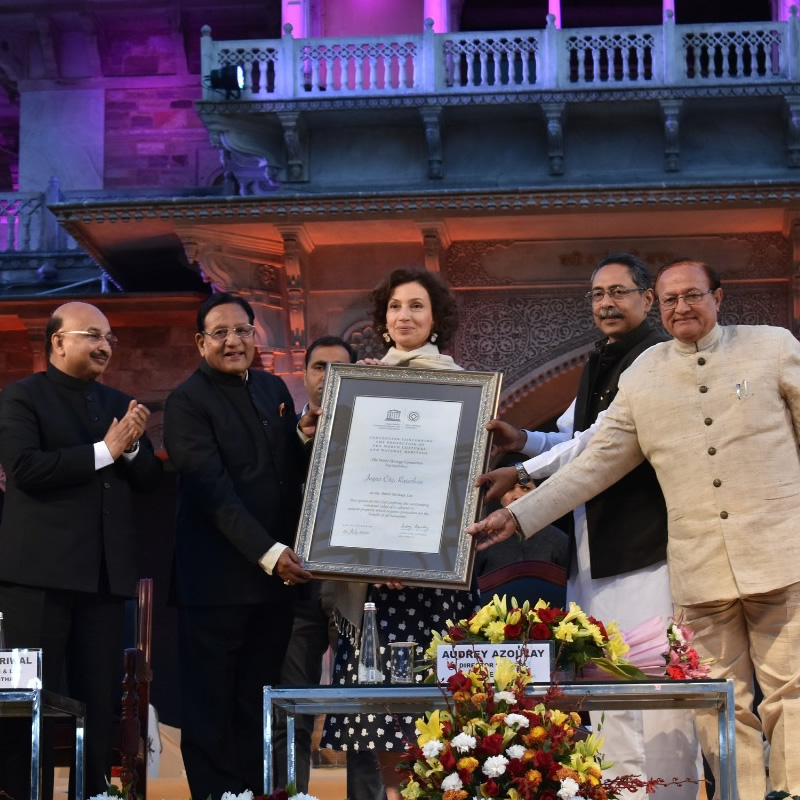


“I bring you an important message from UNESCO’s headquarters in Paris. The global community has formally acknowledged the remarkable efforts of the people of Jaipur in safeguarding their rich cultural heritage. This recognition is a source of immense pride, as UNESCO has officially inscribed Jaipur City on the World Heritage List. Known for its extraordinary urban planning, Jaipur captivates with its vibrant architecture, majestic forts, and opulent palaces, making it a truly enchanting city. This inscription represents a unified commitment to preserving this invaluable cultural legacy,” stated Ms. Azoulay.
“Jaipur possesses a unique and multifaceted identity when it comes to heritage. Its architecture beautifully reflects an exquisite fusion of Persian, Mughal, and Hindu designs, creating a stunning visual narrative. The Amber Fort, with its grand scale and intricate craftsmanship, stands as a quintessential example of this artistic convergence,” she added.
 CitiTimes