

Faculty members from New York University met with the Vice President of India.
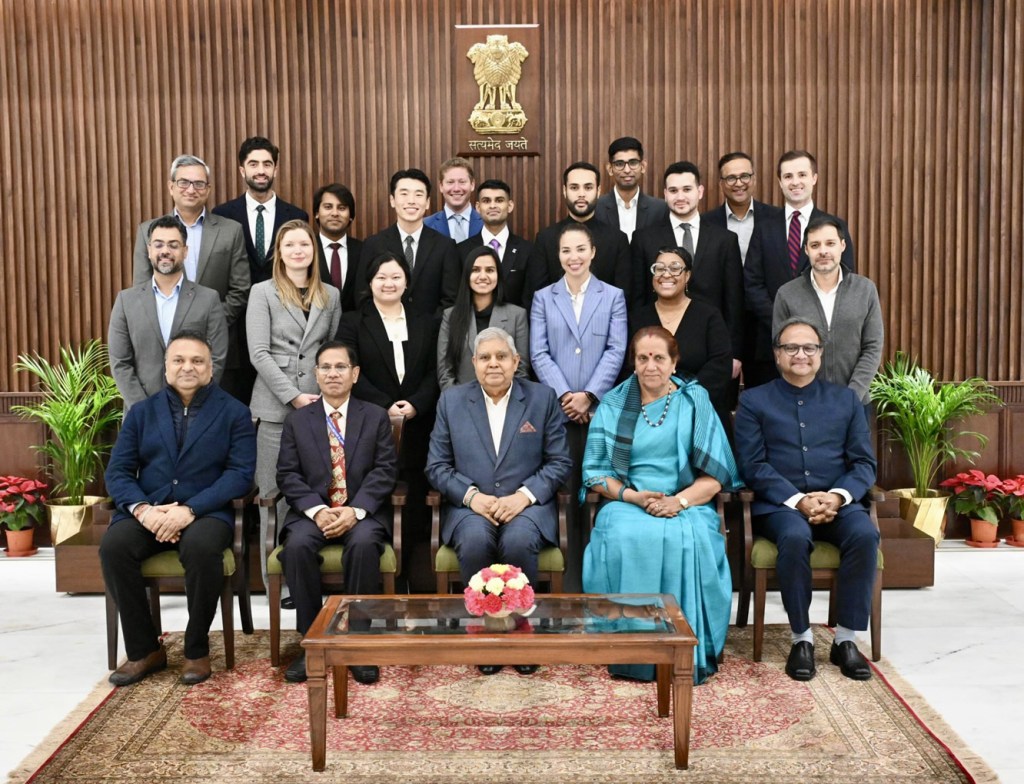
Click here to view the larger version of the photo.
New Delhi, India, January 16, 2025 — A group of faculty members from New York University met with the Vice President of India at the Vice President’s Enclave in New Delhi.
Below are excerpts from the Vice President’s address to a group of faculty members of New York University at the Vice President’s Enclave in New Delhi:
Greetings to everyone! I extend a warm welcome to you all at this establishment; it truly is a delightful moment.
For those visiting this country for the first time, you may not fully appreciate the remarkable changes over the past decade. No other country in the world has undergone such a significant transformation as Bharat has at this time.
The International Monetary Fund (IMF) states that India is a land of opportunity and a favored investment destination. The World Bank has recognized India’s achievements, noting that the progress in digitization made in just six years is typically not attainable in less than four decades. There are solid reasons behind these extraordinary developments.
Can you imagine the impact of including 500 million people in the banking system? I’m talking about 500 million individuals. We have 170 million people benefiting from free fuel collection, and 120 million households now have access to toilets and potable water. Additionally, 5G technology is being made available in villages, and roads connect all villages. I have firsthand experience of this transformation; I served as a Member of Parliament in 1989 and as a minister in 1990. What has happened in this country is truly remarkable. Regarding digitization, we are setting an example for the world.
India stands for inclusivity, reflected in the G20 motto, “One Earth, One Family, One Future.” This motto is inspired by our 5,000-year-old civilizational ethos of Vasudhaiva Kutumbakam, which emphasizes the belief that the world is one family. We believe in this principle, and the global perception of India needs to change accordingly.
Now, there is an ecosystem, and the ecosystem is very categorical.
The opportunity basket for youth is enlarging; there is no field of human activity where India is not aligned with futuristic intentions so that you can find out from that perspective. Silicon Valley is a new reality. One in five unicorn founders is Indian, making Indian leadership the new normal.
1,40,000 startups and 160 new unicorns demonstrate how transformative the landscape has been for youth contributions, supported by innovative and far-reaching policies that assist entrepreneurs at every stage and improve ease of governance.
What you saw earlier, India has accomplished now: the rule of law. There is equality before the law, come what may. No privilege pedigree, no one is immune from the process of law. Complex but achieved effectively and impactfully, it’s a ground reality.
We prioritize transparent and accountable governance by comparing ourselves to the best in the world, particularly regarding internet accessibility and adaptability. Interestingly, the per capita internet consumption of an Indian exceeds that of both the US and China combined. Regarding direct digital transactions, I come from a village where 100 million farmers receive direct payments thrice a year. At a global level, our transactions account for more than 50%, surpassing the combined transactions of the USA, UK, France, and Germany four times. Our economy has evolved from being labeled the “Fragile Five” to the “Big Five,” putting us ahead of our former colonial rulers, the UK. We are committed to not leaving anyone behind as we move forward and are poised to surpass Japan and Germany.
Your visit to this country is significant because India stands for peace, stability, and global growth. It’s a nation that never subscribes to expansion; historically, it has believed in resolving disputes through dialogue and diplomacy.
I want you to notice that India is a cultural center of the world. No other country can claim a history of 5,000 years of culture. If you travel to any part of this country, you’ll find distinct infrastructure, cuisine, and cultural differences. You are visiting during a significant event that occurs once every 144 years: the Mahakumbh. Can you imagine how many people will attend? Around 400 million people will gather at this location over just a few weeks, and you will observe that the management of this event is seamless. Everyone is taken care of in a well-organized and efficient manner. Things have changed dramatically.
In the past decade, our economy has grown from two to four trillion, achieving an impressive average growth rate of 8%. When compared to other large economies, the difference becomes apparent. We construct 14 kilometers of world-class highways and 6 kilometers of railway tracks daily. Annually, we add four new airports and one metro system, resulting in a 1,000-kilometer metro network across 23 cities. This progress indicates that we are ahead of Japan and reflects India’s rapid urbanization.
Source: Vice President’s Secretariat
 CitiTimes