
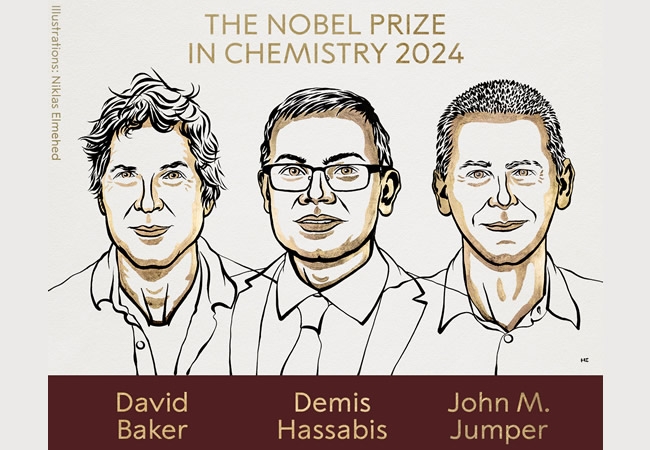
- David Bake, University of Washington, Seattle, WA, USA, and Demis Hassabis and John M. Jumper of Google DeepMind, London, are awarded the Nobel Prize in Chemistry for 2024.
- They cracked the code for proteins’ structures.
Stockholm, October 09, 2024 — The Royal Swedish Academy of Sciences has decided to award the Nobel Prize in Chemistry 2024. One-half of the prize goes to David Bake from the University of Washington, Seattle, WA, USA, for his work in computational protein design. The other half is jointly awarded to Demis Hassabis and John M. Jumper from Google DeepMind, London, UK, for their contributions to protein structure prediction.
The 2024 Nobel Prize in Chemistry is centered around proteins, the ingenious chemical tools of life. David Baker has achieved the almost impossible task of creating entirely new types of proteins. Demis Hassabis and John Jumper have developed an AI model to solve a 50-year-old problem: predicting the complex structures of proteins. These discoveries have tremendous potential.
The incredible diversity of life showcases the remarkable capacity of proteins as chemical tools. Proteins play a crucial role in controlling and driving all the chemical reactions forming life’s foundation. Additionally, they serve as hormones, signal substances, antibodies, and the building blocks of various tissues.
“One of the discoveries being recognized this year concerns the construction of spectacular proteins. The other is fulfilling a 50-year-old dream: predicting protein structures from their amino acid sequences. Both of these discoveries open up vast possibilities,” says Heiner Linke, Chair of the Nobel Committee for Chemistry.
Proteins comprise 20 different amino acids and can be considered the building blocks of life. In 2003, David Baker achieved a breakthrough by using these building blocks to create an entirely new type of protein. Since then, his research group has continued to develop innovative proteins, some of which have potential applications as pharmaceuticals, vaccines, nanomaterials, and small-scale sensors.
The second discovery relates to predicting protein structures. Proteins comprise long strings of amino acids that fold into a three-dimensional structure, which is crucial for the protein’s function. Since the 1970s, researchers have attempted to predict protein structures from amino acid sequences, but this has not been easy. However, four years ago, there was a remarkable breakthrough.
In 2020, Demis Hassabis and John Jumper introduced an AI model named AlphaFold2. Using this model, they successfully predicted the structure of nearly all 200 million proteins identified by researchers. Since its breakthrough, AlphaFold2 has been utilized by over two million people from 190 countries. This technology has numerous scientific applications, enabling researchers to gain a deeper understanding of antibiotic resistance and to generate images of enzymes capable of breaking down plastic.
Life is dependent on proteins for its existence. The ability to accurately predict protein structures and engineer customized proteins represents an unparalleled advancement with profound implications for the betterment of humanity.
Source: The Royal Swedish Academy of Sciences
 CitiTimes