
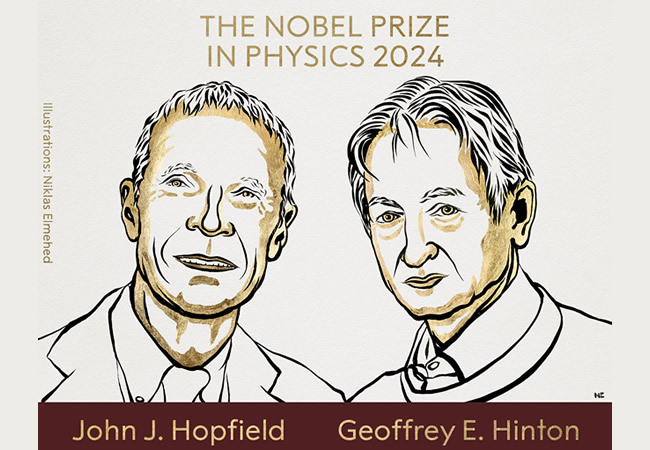
- John J. Hopfield of Princeton University and Geoffrey E. Hinton of the University of Toronto are awarded the Nobel Prize in Physics for 2024.
Stockholm, October 08, 2024 — The Royal Swedish Academy of Sciences has decided to award the Nobel Prize in Physics for 2024 to John J. Hopfield of Princeton University, NJ, USA, and Geoffrey E. Hinton of the University of Toronto, Canada. The prize recognizes their groundbreaking discoveries and inventions that have paved the way for machine learning using artificial neural networks.
This year, the two Nobel Laureates in Physics have used physics tools to develop methods that form the basis of today’s powerful machine learning. John Hopfield created an associative memory that can store and reconstruct images and other types of patterns in data. Geoffrey Hinton invented a method that can autonomously find properties in data and, therefore, perform tasks such as identifying specific elements in pictures.
Artificial intelligence typically involves machine learning through artificial neural networks initially inspired by the brain’s structure. In an artificial neural network, nodes represent the brain’s neurons and possess varying values. These nodes interact with each other through connections that resemble synapses and can be adjusted to become stronger or weaker. The network is trained by reinforcing connections between nodes with concurrent high values. This year’s laureates have significantly contributed to the development of artificial neural networks since the 1980s.
John Hopfield developed a network that can store and retrieve patterns. In this network, we can think of the nodes as pixels. The Hopfield network is based on the physics of atomic spin, which is a property that makes each atom act like a tiny magnet. The network as a whole is described in a way that is similar to the energy in a spin system found in physics. It is trained by determining values for the connections between the nodes so that the saved images have low energy. When the Hopfield network is given a distorted or incomplete image, it systematically updates the values of the nodes to decrease the network’s energy. It allows the network to find the saved image that most closely resembles the imperfect one it was given.
Geoffrey Hinton innovatively utilized the Hopfield network to develop the Boltzmann machine, a novel network that can recognize characteristic elements in specific data types. The machine is trained by exposing it to examples that are highly likely to occur during its operation. As a result, the Boltzmann machine can effectively classify images and generate new examples of the patterns on which it was trained. Hinton’s groundbreaking work has played a pivotal role in catalyzing the current explosive growth of machine learning.
“The laureates’ work has already been of great benefit. In physics, we use artificial neural networks in many areas, such as developing new materials with specific properties,” said Ellen Moons, Chair of the Nobel Committee for Physics.
Source: The Royal Swedish Academy of Sciences
 CitiTimes